Almost Famous
The turntable that taught a 15-year-old to listen — Lester Bangs' setup, identified.
The scene
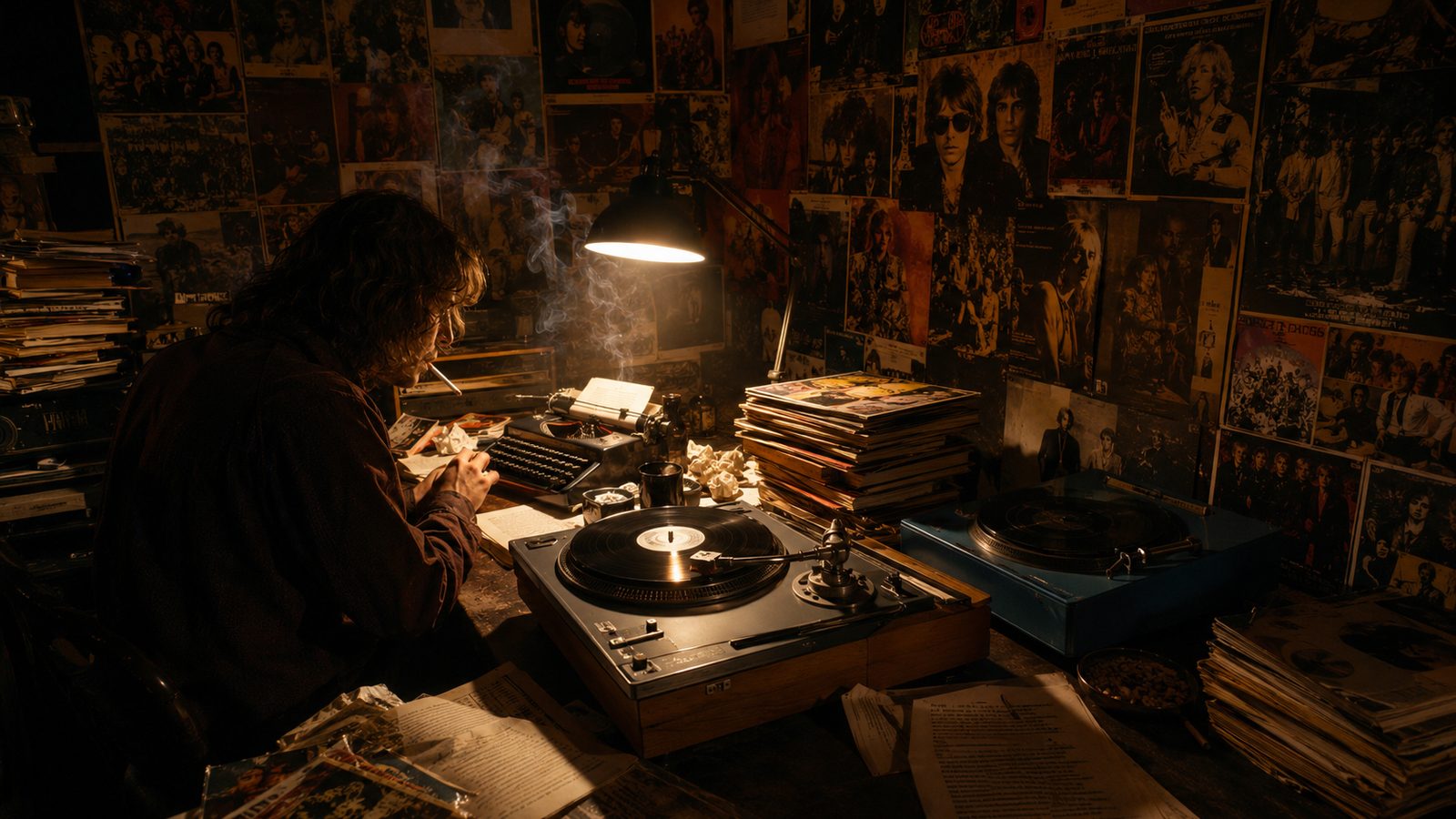
Lester Bangs' apartment. Stacks of records everywhere — on the desk, on the floor, leaning against the walls. A typewriter sits next to a turntable, both tools of the same trade. The room smells like cigarettes and deadline pressure. This is where rock criticism happens.
Cameron Crowe's semi-autobiographical 2000 film follows 15-year-old William Miller into the world of 1970s rock journalism. The turntable in Lester Bangs' apartment isn't just set dressing — it's the center of gravity. When Bangs plays a record for William, he's not just sharing music. He's teaching him how to hear. The turntable is the classroom.
The production design nails the details. Crowe, who was himself a teenage rock journalist, knew exactly what a critic's apartment looked like in 1973.
The gear
The primary turntable visible in Bangs' apartment is a Russco — a broadcast-grade turntable made by Russco Electronics of Los Angeles. Russco turntables were workhorses of radio stations and recording studios, built for durability and constant use rather than audiophile purity. The choice is authentic: a working critic in the 1970s would have had access to broadcast equipment, not consumer hi-fi.
The tonearm is an SME 3012, a 12-inch precision tonearm made by SME (Scale Model Equipment) in England. The 3012 was the gold standard for professional turntable arms — broadcast studios, mastering facilities, and serious record collectors all relied on SME for tracking accuracy and build quality. An SME arm on a Russco deck is the setup of someone who plays records for a living.
A second turntable — described in production notes as having a blue platter — is also visible. The apartment has two turntables because a critic needs one playing while cueing up the next record. It's not DJing — it's the analog version of tabbed browsing.
"The only true currency in this bankrupt world is what you share with someone else when you're uncool."
Why it matters
Almost Famous captured the romance of physical media at the exact moment digital was about to kill it. The turntable in Bangs' apartment isn't a lifestyle accessory — it's a tool for understanding music at the molecular level. You drop the needle, you listen, you type what you hear. The turntable is the interface between the music and the criticism.
For the collector market, Russco turntables are a niche item — they don't have the brand recognition of Technics or Thorens, but they're built like tanks and offer genuine broadcast-quality performance. The real collector value is in the SME tonearms: vintage SME 3012s command $500–$3,000+ depending on condition and variant. They're precision instruments that are still considered competitive with modern designs.
The film's influence on the vinyl revival is hard to separate from High Fidelity, released the same year. Together, the two films created a cultural moment where owning records — and the equipment to play them properly — became a signifier of authenticity. Almost Famous made the turntable sacred. High Fidelity made the record store sacred. Between them, they built the foundation for everything that followed.
Affiliate disclosure: We may earn a commission from qualifying purchases made through links on this page, at no extra cost to you.
Russco Turntable + SME 3012
Broadcast-grade Russco deck fitted with an SME 3012 12-inch precision tonearm. The setup of someone who plays records professionally — built for accuracy, not aesthetics.
- Era
- 1970s
- Type
- Broadcast turntable
- eBay market
- SME 3012: $500–$3,000+
- Condition note
- SME arms hold value; Russco decks are niche
Audio-Technica AT-LP7
Serious belt-drive turntable with a VM520EB cartridge. The kind of deck a modern music critic would use — accurate, revealing, and designed for critical listening.
View on Amazon →Pro-Ject Debut Carbon EVO
Austrian turntable with a carbon fiber tonearm. Clean, detailed sound that rewards close listening. Bangs would appreciate the engineering, if not the price.
View on Amazon →Technics SL-1500C
Direct-drive Technics with modern refinements. The broadcast-quality DNA of the Russco meets Japanese precision. Built to play records all day, every day.
View on Amazon →