American Psycho
Every component in Patrick Bateman's obsessive stereo system — identified.
The scene
Patrick Bateman puts on a CD. He has something important to say about Huey Lewis and the News. The camera lingers on his stereo system — a pristine wall of silver and black components, perfectly aligned, obsessively maintained. Everything in Bateman's apartment is a status symbol, and the stereo is no exception. It's not just expensive — it's aggressively, performatively expensive.
Mary Harron's 2000 adaptation of Bret Easton Ellis's novel uses the stereo system as a character detail: Bateman doesn't just own music, he owns the equipment. The monologues about Whitney Houston and Phil Collins happen with the stereo visible, humming, waiting. The gear is part of the ritual.
But what's actually on that shelf?
The gear
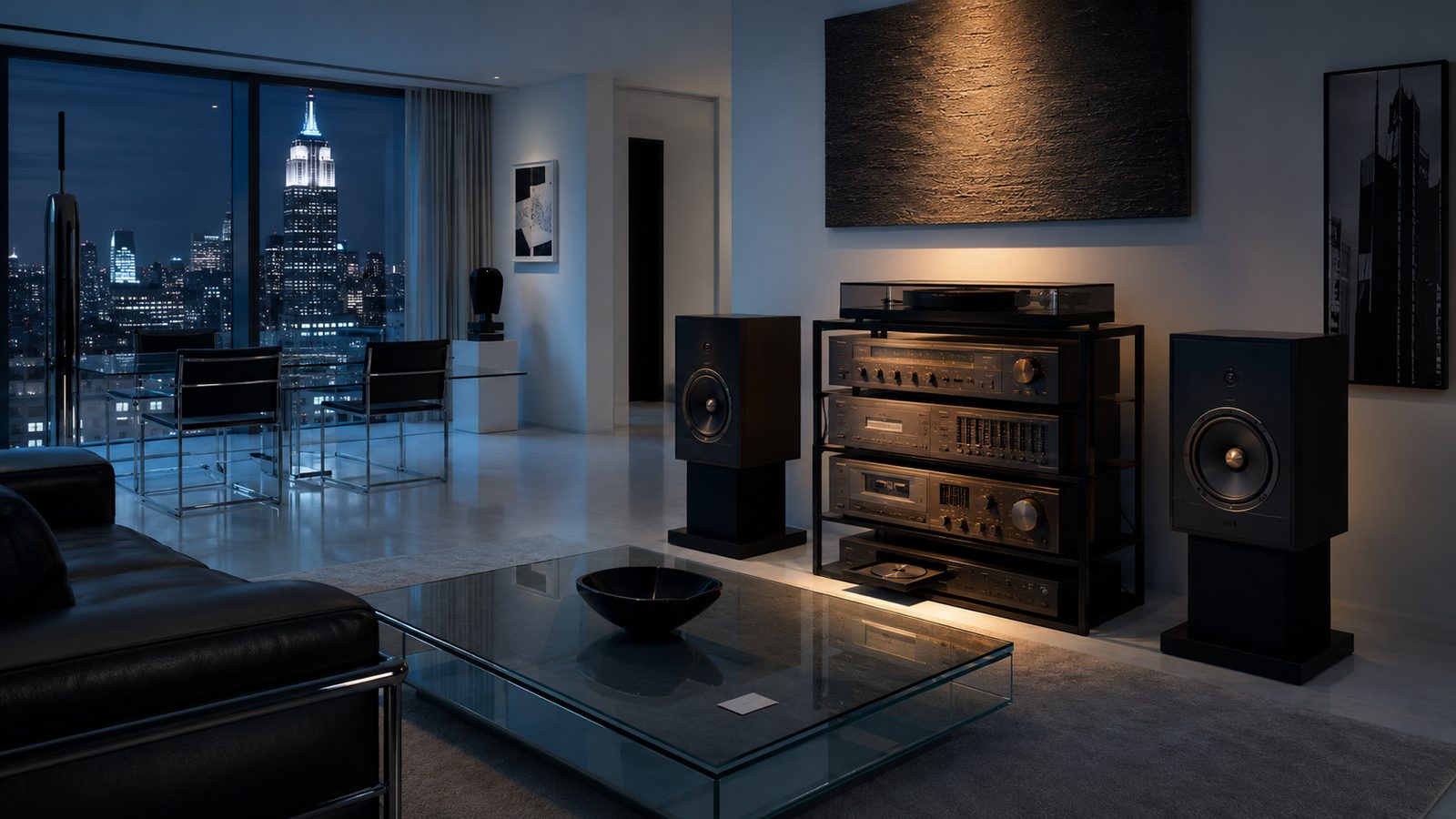
Bateman's audio system is a full Harman Kardon 700 series component stack from the late 1980s. The visible components include an HK 770 power amplifier, an HK 725 preamplifier, an HK EQ7 graphic equalizer, and an HK 440xm dual cassette deck. On the shelf alongside them sits a Pioneer PD-4300 CD player — the disc tray we see open and close.
Flanking the stack are a pair of KEF speakers. The exact KEF model is debated among prop hunters, but they're consistent with KEF's Reference or C-series from the late '80s — clean, British, expensive. The entire system screams "I read the spec sheets before I bought this," which is exactly the point.
Harman Kardon's 700 series was a serious audiophile line in its day. The HK 770 delivered clean, high-current power — the kind of amplifier that audio magazines praised for its measured performance. For Bateman, measured performance is everything.
"Do you like Huey Lewis and the News?"
Why it matters
American Psycho turned a stereo system into a personality test. Bateman's gear isn't chosen for warmth or musicality — it's chosen because the components photograph well and the brand name impresses the right people. It's conspicuous consumption as pathology, and the Harman Kardon stack is the perfect prop: real audiophile credentials, but cold, clinical, and perfectly matched.
For the vintage market, the HK 770 and 725 are well-regarded components that fly under the radar compared to flashier brands like McIntosh or Marantz. The American Psycho connection has started to push prices up — especially for clean, matching sets. The Pioneer PD-4300 remains a solid vintage CD player, though it's the HK stack that collectors want to recreate.
The film also quietly made KEF speakers cool in the U.S. market. British hi-fi had always had a following, but seeing KEFs in Bateman's meticulously curated apartment gave the brand an aspirational edge it hadn't quite had before in American pop culture.
Affiliate disclosure: We may earn a commission from qualifying purchases made through links on this page, at no extra cost to you.
Harman Kardon HK 770
Bateman's power amp. A high-current twin-drive design from HK's 700 series, known for clean power delivery and a minimalist black faceplate that matched his apartment's aesthetic perfectly.
- Era
- Late 1980s
- Type
- Power Amplifier
- eBay market
- $200–$500
- Condition note
- Clean units hold value
Harman Kardon HK 725
The matching preamplifier from the 700 series. Handles input switching, volume, and tone control. Paired with the 770, this is the command center of the system.
- Era
- Late 1980s
- Type
- Preamplifier
- eBay market
- $150–$400
- Rarity
- Less common than the 770
Pioneer PD-4300
The disc player visible in the famous monologue scenes. A mid-range Pioneer from the late '80s with a stable transport and clean digital output — exactly the kind of component Bateman would research before buying.
- Era
- Late 1980s
- Type
- CD Player
- eBay market
- $80–$200
- Condition note
- Trays can stick with age
Harman Kardon HK 3770
Modern HK stereo receiver. Same brand DNA, same clean power philosophy. Bateman would approve of the Bluetooth and network streaming — more features to monologue about.
View on Amazon →KEF LS50 Meta
Modern KEF bookshelf speakers with their signature Uni-Q concentric driver. British precision engineering that would fit right in on Bateman's shelf — if he had taste instead of just money.
View on Amazon →Cambridge Audio CXA81
British integrated amplifier with a clean, clinical aesthetic. Silver faceplate, minimal controls, serious power. The kind of amp that rewards obsessive attention to specs.
View on Amazon →