The Gear Behind Daft Punk's Homework
Two guys in a Paris apartment with a $300 compressor, a TB-303, and a dream. The album that launched French house was made on gear you could fit in a closet.
The Scene
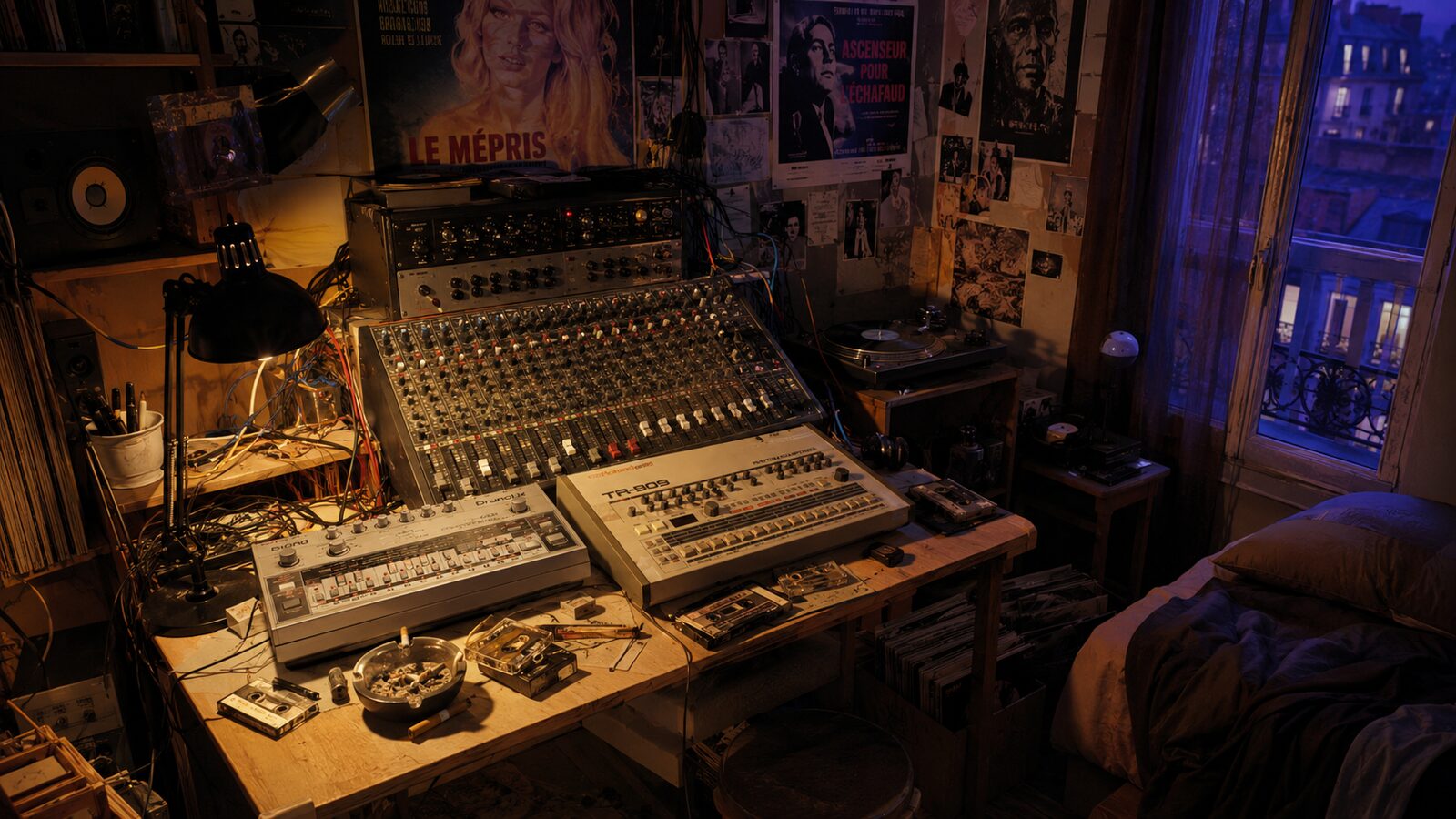
Before the helmets, before the Grammys, before Random Access Memories was recorded on a Neve 88R at Conway Studios with a 100-piece orchestra, Thomas Bangalter and Guy-Manuel de Homem-Christo were two kids in a Paris apartment making music on secondhand gear. Homework was recorded in Thomas's bedroom, a space barely big enough for a desk and a bed, crammed with machines and cables.
The setup was spartan by any professional standard. A Mackie CR-1604 mixer — the affordable workhorse of 1990s home studios — sat at the center of the rig. A Roland TB-303 Bassline provided the acid squelch that drives "Rollin' & Scratchin'" and "Alive." A Roland TR-909 laid down the four-on-the-floor kicks. And the entire thing was run through an Alesis 3630 compressor that cost about $300 new.
That was it. No console. No engineer. No label money. Just two friends who'd been making music together since they were teenagers, recording to DAT tape in a walk-up apartment while their neighbors probably hated them.
The Gear
The Roland TB-303 Bassline is the acid house machine. Designed in 1981 as a bass accompaniment tool for solo guitarists, it was a commercial failure — Roland discontinued it after 18 months. DJs in Chicago and Detroit discovered that its squelchy, resonant filter sweeps could create entirely new sounds when pushed to extremes. By the time Daft Punk got their hands on one, the 303 was already a legend, but it hadn't yet become the $5,000+ collector's item it is today.
The Roland TR-909 is equally foundational. The first drum machine to combine analog and digital sounds, it defined house and techno from Detroit to Berlin to Paris. Bangalter used it throughout Homework, most prominently on "Da Funk," where the 909 kick cuts through a distorted bassline with surgical precision.
But the secret weapon was the humble Alesis 3630 compressor. In a 2001 interview with Mix Magazine, Guy-Manuel said it plainly: the Alesis was the most-used piece of outboard gear on both Homework and Discovery. One of the cheapest compressors on the market made two of the most influential electronic albums ever recorded.
The Mackie CR-1604 mixer rounded out the setup — a 16-channel board that was the default choice for bedroom producers, small studios, and live DJs throughout the 1990s. Nothing glamorous, nothing exotic. Just a clean signal path and enough inputs to run everything.
"We have a really small compressor, the Alesis 3630, which is $300. That's the main one we used on Homework and Discovery. The one we used the most is one of the cheapest ones on the market."— Guy-Manuel de Homem-Christo, Mix Magazine (2001)
Why It Matters
Homework sold over two million copies worldwide and launched the French house movement that reshaped electronic music for the next decade. It proved that you didn't need a proper studio, a mixing engineer, or expensive gear to make a record that would change the world. You just needed ideas, taste, and a 303.
For gear collectors, the Homework rig is a study in appreciation curves. The TB-303, which could be found for $200 at flea markets in the early 1990s, now commands $4,000–$6,000 on the vintage market. The TR-909 has followed a similar trajectory, climbing from unwanted surplus to $3,000+ collector's item. Even the Mackie CR-1604 — a mixer nobody thought twice about — has developed a cult following among producers chasing the specific sound character of 1990s home recording.
The Alesis 3630, remarkably, is still the bargain. Used units sell for $50–$120 on eBay, making it the single most affordable piece of gear associated with a multi-platinum album. If you want to own a piece of Homework, the 3630 is the entry ticket.
The Gear Cards
Affiliate disclosure: We may earn a commission from qualifying purchases made through links on this page, at no extra cost to you.
Roland TB-303
The acid house machine. Discontinued after 18 months in 1982, then adopted by Chicago DJs and eventually by Daft Punk for the squelchy, filter-swept bass that defines Homework. Originals are now holy-grail collector's items.
Roland TR-909
The first hybrid analog/digital drum machine. Its kick, snare, and hi-hats are the foundation of house, techno, and everything Daft Punk built on Homework. "Da Funk" is essentially a 909 showcase.
Alesis 3630 Compressor
The cheapest compressor on the market — and the most-used piece of outboard on Homework and Discovery, according to Guy-Manuel himself. Proof that price has nothing to do with impact.
Modern Alternatives
Roland TB-03 Bass Line
~$350Roland's official Boutique-series recreation of the TB-303. Same sound engine, same sequencer workflow, modern connectivity. The affordable way into acid.
View on Amazon →Roland TR-8S Rhythm Performer
~$600Modern drum machine with ACB models of the 909, 808, 707, and more. The entire Roland drum machine legacy in one box.
View on Amazon →Mackie 1604VLZ4 Mixer
~$800The direct descendant of the CR-1604 that Daft Punk used. Same clean preamps, same bulletproof build, updated connectivity.
View on Amazon →