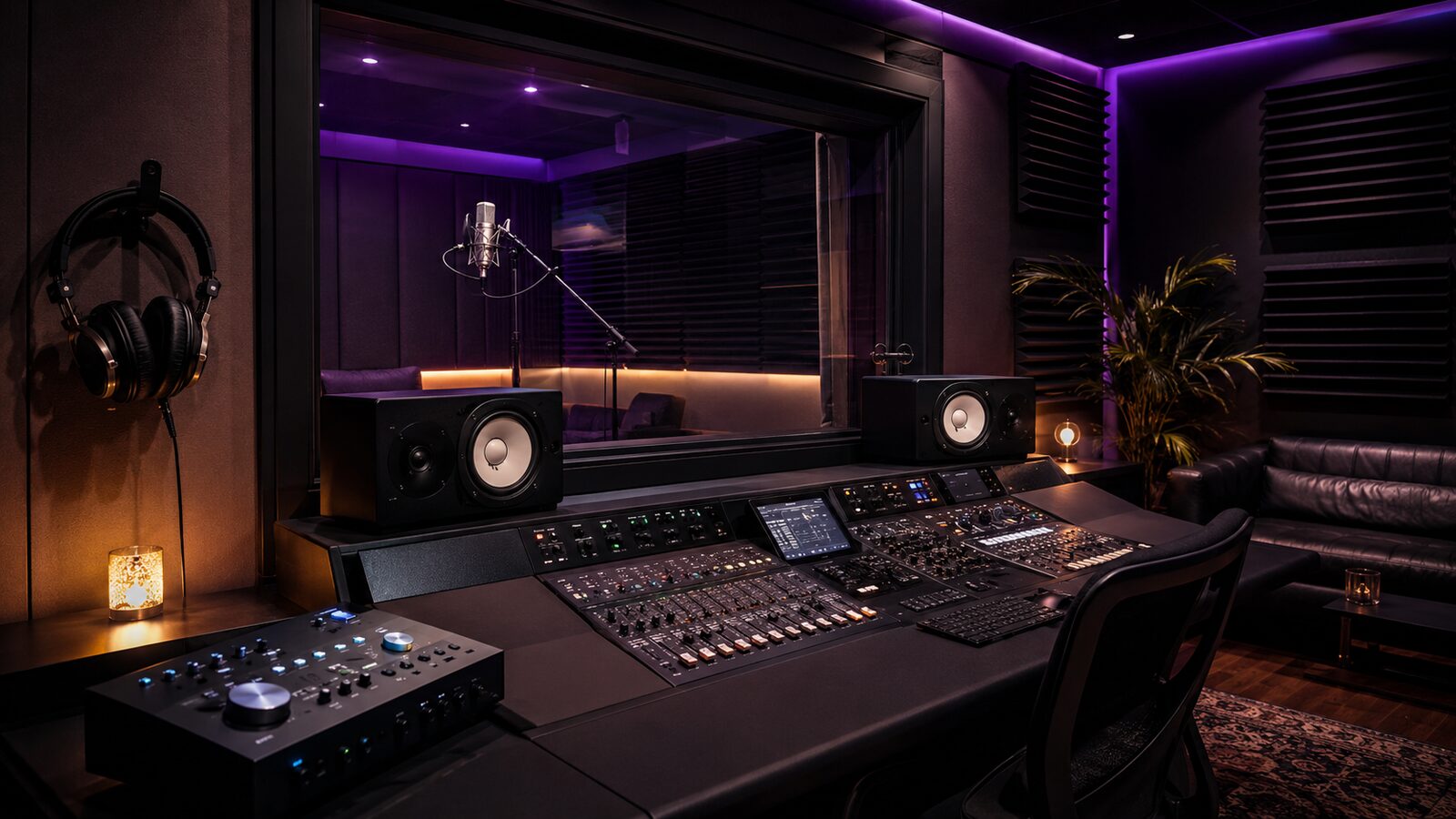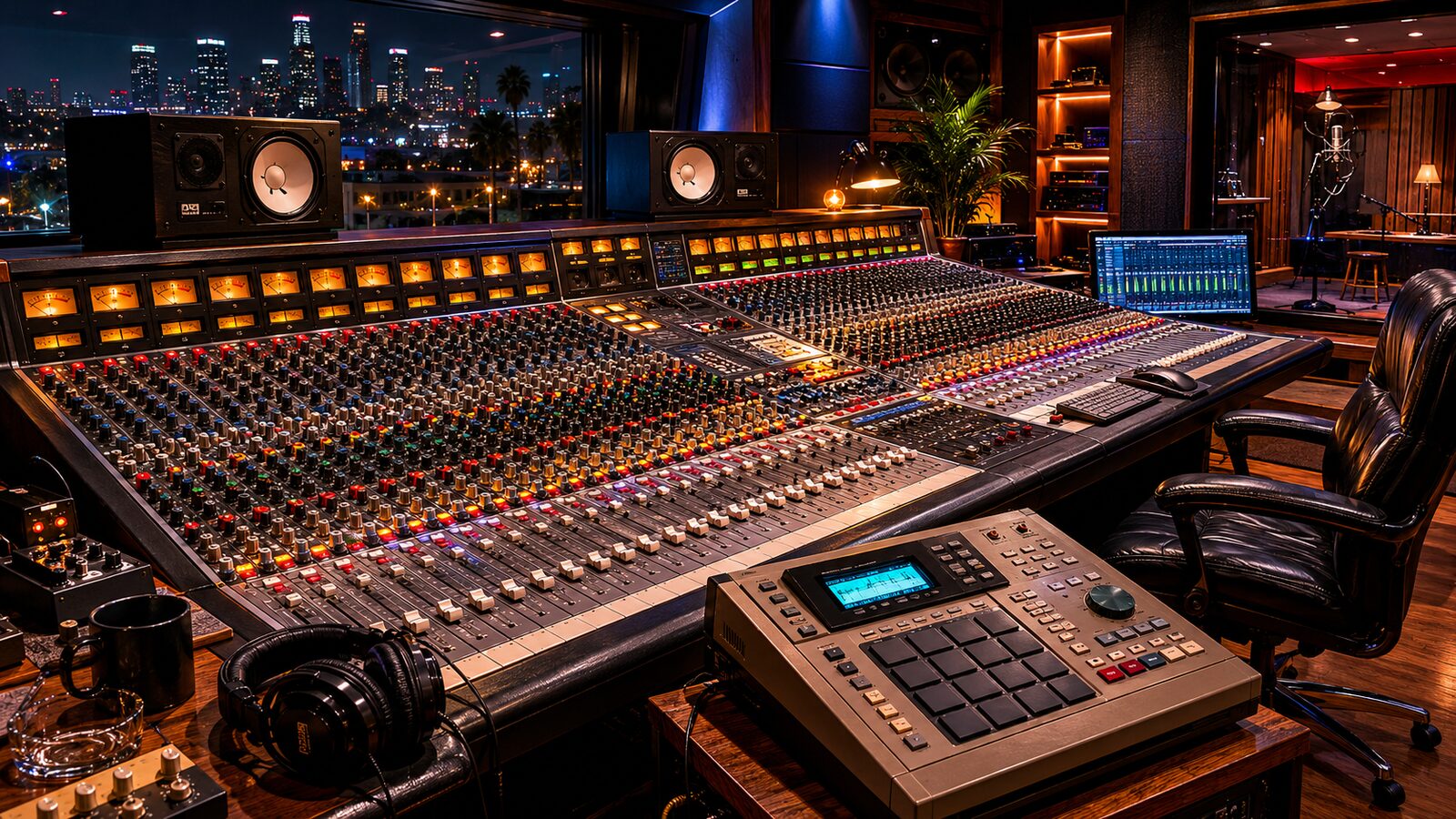
Aftermath Entertainment Studios, Los Angeles. An SSL 4000 G+ mixing console stretches across the room — hundreds of knobs, faders, and buttons in perfect alignment, their red and green indicator lights creating a cockpit-like glow. A pair of Yamaha NS-10 monitors sit on the meter bridge, their white cones unmistakable. An Akai MPC 3000 — the sampling drum machine that created a decade of West Coast hip-hop — is positioned within arm's reach of the engineer's chair. Through the window, the Los Angeles skyline glimmers.
Before Beats headphones made him a billionaire, Dr. Dre was one of the most meticulous audio engineers in hip-hop. His Aftermath studio is built around an SSL 4000 console — the same desk architecture used on most major hip-hop, R&B, and pop records since the 1980s. The room is pristine, serious, and engineered for perfection: dark walls, perfect acoustic treatment, soft recessed lighting. Every surface is designed to serve the music.
The SSL 4000 G+ is the recording industry's most successful mixing console. Solid State Logic's flagship desk, introduced in the early 1980s, became the standard for pop, hip-hop, and R&B production. Its transparent preamps, musical EQ, and legendary bus compressor defined the sound of a generation. Dre's SSL is the central nervous system of Aftermath — every mix decision, every automation move, every final master passes through its circuitry.
The Yamaha NS-10 monitors on the meter bridge are the same model used in virtually every professional studio since the 1980s. Dre's mixing philosophy starts with the NS-10s: if the bass, the vocals, and the drums sound right on these small, unforgiving speakers, they'll translate to car stereos, club systems, and — eventually — Beats headphones. The irony is deliberate: the man who created a $3 billion headphone company mixed his most important records on $500 speakers.
The Akai MPC 3000 is the sampling workstation that created the West Coast hip-hop sound. Dre used the MPC to chop soul samples, program drum patterns, and build the layered, G-funk productions that defined The Chronic, 2001, and the Aftermath catalog. The MPC's slightly gritty 12-bit sampling gives sampled material a warmth and crunch that modern digital sampling can't replicate.
People are going to hear what I hear now.— Dr. Dre, on launching Beats by Dre
Dr. Dre's journey from studio engineer to consumer electronics billionaire is unique in music history. The same ears that mixed The Chronic on Yamaha NS-10s went on to design Beats by Dre — a headphone brand that Apple acquired for $3 billion in 2014. The connection between his studio gear and his consumer products is direct: Dre's entire career has been about how bass sounds, how vocals sit in a mix, and how music feels at volume.
SSL 4000 console modules sell for $500 to $2,000 each on the used market. Yamaha NS-10 monitors go for $500 to $1,200 per pair. The Akai MPC 3000 — discontinued and increasingly rare — commands $3,000 to $6,000. AKG C414 microphones, used for vocal tracking at Aftermath, range from $800 to $1,200.
The lesson of Dre's rig is precision. Every piece of equipment in Aftermath Studios was chosen for a specific reason, tested exhaustively, and integrated into a workflow designed around one person's hearing. The studio isn't a collection of expensive gear — it's an instrument, tuned to the preferences of the most commercially successful audio engineer in hip-hop history.
Affiliate disclosure: We may earn a commission from qualifying purchases made through links on this page, at no extra cost to you.
Solid State Logic's flagship studio console. Transparent preamps, musical EQ, and the legendary SSL bus compressor that defined the sound of modern pop and hip-hop.
The sampling drum machine that built West Coast hip-hop. 12-bit sampling, tactile pads, and the gritty warmth that digital can't touch.
SSL's own USB audio interface with their legendary preamp and bus compressor character. Aftermath studio sound for your desk.
View on Amazon →Modern standalone MPC with classic workflow and modern features. The direct descendant of Dre's MPC 3000.
View on Amazon →Yamaha's modern studio monitor — the spiritual successor to the NS-10 that Dre mixed on.
View on Amazon →As an Amazon Associate we earn from qualifying purchases.