Help!
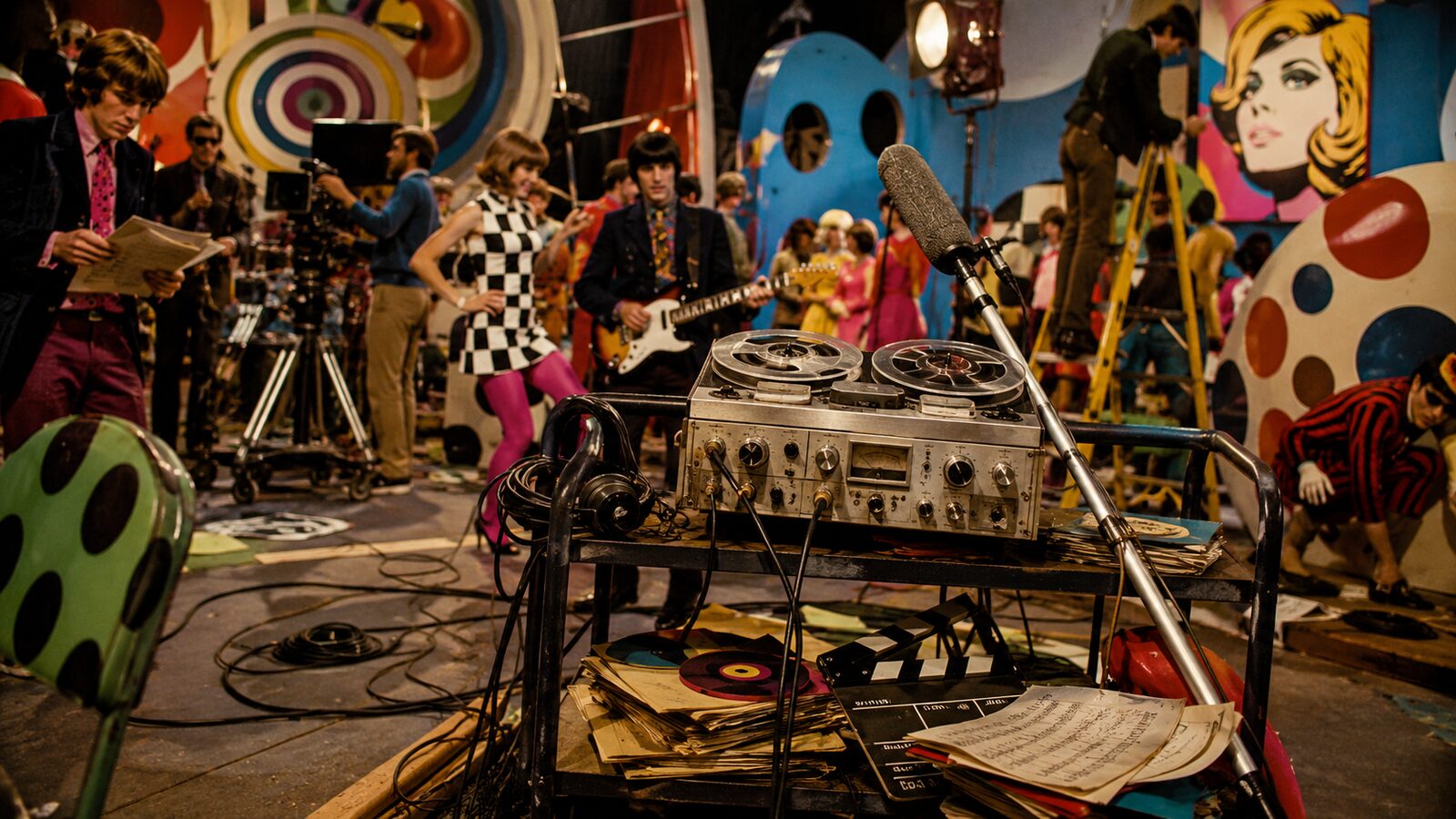
London, Nassau, the Austrian Alps, Salisbury Plain — 1965. Richard Lester's second Beatles film is a Technicolor whirlwind of slapstick, psychedelia, and mod fashion. Among the cameras, clapperboards, and tangled cables of the film crew, a Nagra reel-to-reel recorder sits on a dolly cart, capturing the chaos.
Help! was one of the most ambitious productions of the British New Wave era, shooting across four countries in eleven weeks. The production sound department relied on Nagra recorders as the standard location recording tool — the same machines being used on virtually every major European and American film production of the 1960s.
The Nagra appears in background shots throughout the film's behind-the-scenes footage, a quiet workhorse in a production defined by noise, color, and controlled pandemonium. It's the most serious object on the most unserious film set in cinema history.
The Nagra III visible in Help!'s production was the dominant location sound recorder of the 1960s film industry. By 1965, it had already become the standard tool for major productions on both sides of the Atlantic, replacing the bulkier and less reliable magnetic film recorders that preceded it.
The Nagra's advantage on a chaotic set like Help! was its portability and speed. A sound recordist could grab the machine by its iconic top handle, follow the action anywhere, and produce broadcast-quality recordings without the infrastructure of a sound truck. On a production that moved between studios, beaches, ski slopes, and open fields, that mobility was essential.
The Beatles themselves were no strangers to reel-to-reel technology. By 1965, they were deep into the Abbey Road sessions that would produce Rubber Soul, working with the Studer J37 four-track machines that defined the EMI sound. The Nagra on the film set was the field counterpart to the studio machines they knew intimately.
I'm not an actor — I'm a Beatle. That's something else entirely.
— John Lennon, during the filming of Help!
Help! is a time capsule of 1960s British pop culture at its most exuberant. The film's behind-the-scenes documentation provides one of the best records of professional film production equipment of the era, including the Nagra recorders that were essential to every serious production.
The Nagra III's role in 1960s cinema cannot be overstated. It recorded the location sound for films ranging from the French New Wave to Hollywood blockbusters, and its presence on the Help! set connects the Beatles — already the most documented band in history — to the broader story of professional audio technology.
For collectors, a Nagra III from the 1960s carries the aura of the era. These machines recorded the sounds of a decade that changed everything — from Beatles film sets to Vietnam War dispatches to the moon landing broadcasts. Working examples remain available on eBay at $1,200–$3,500.
Nagra III Portable Recorder
The location sound recorder that captured the 1960s — from Beatles film sets to the French New Wave. The machine that made portable professional audio possible.
Zoom F3 Field Recorder
32-bit float dual-channel field recorder — the spiritual heir to the Nagra for independent film production.
Sound Devices MixPre-6 II
6-input field mixer/recorder with USB interface. The professional standard for location sound in 2024.
Rode NTG5 Shotgun Microphone
Broadcast-grade shotgun mic for film and documentary — what the boom operator on Help! would use today.