Home / As Seen In / Albums
The Gear Behind Mac DeMarco’s Lo-Fi Sound
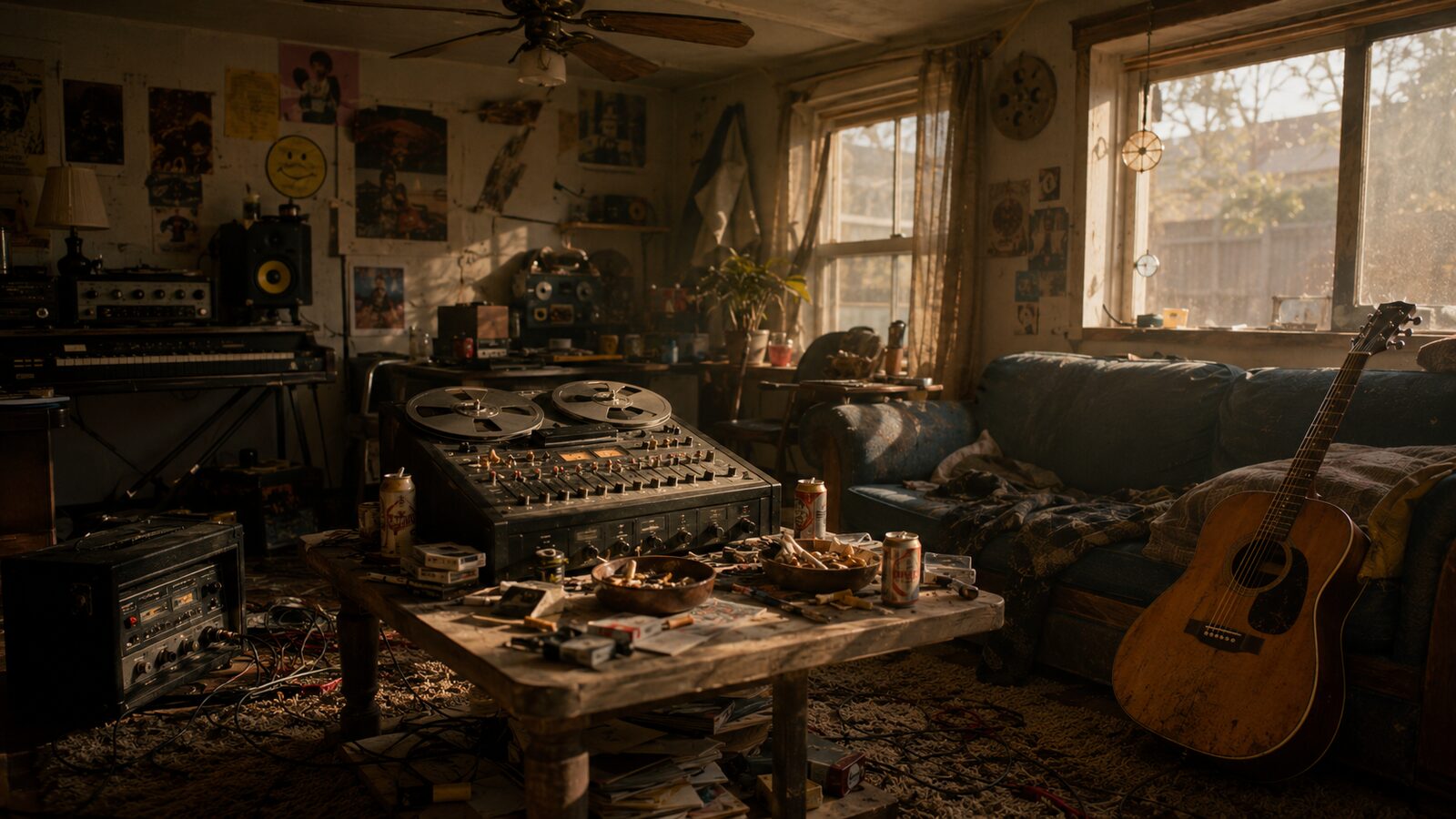
A Tascam 388 on a coffee table, a Roland Space Echo on the floor, and beer cans everywhere. Mac DeMarco made three of the most beloved indie records of the 2010s in his living room, and he singlehandedly drove vintage tape gear prices through the roof.
📺 Album / Production 📅 2012–2015 ⏱ 8 min read
The Scene
Mac DeMarco’s recording career is a progression through increasingly capable tape machines, each one still cheaper than a single day of proper studio time. He started with a Tascam 244 four-track cassette Portastudio for Rock and Roll Night Club (2012), graduated to a Fostex A-8 eight-track reel-to-reel for 2 (2012) and Salad Days (2014), and finally moved to a Tascam 388 — an all-in-one eight-track reel-to-reel mixer — for Another One (2015).
The studio was whatever room he happened to be living in. For Salad Days, that was a house in Far Rockaway, Queens, where the Fostex sat on a table surrounded by ashtrays, empty cans, and patch cables draped across furniture. The Roland Space Echo RE-201 provided the dub-influenced tape delay and spring reverb that became DeMarco’s signature warble. A Roland CR-78 drum machine added skeletal, clicking rhythms.
Nothing was treated carefully. Nothing was precious. DeMarco recorded in his underwear, tracked vocals in the kitchen, and bounced mixes to whatever format was convenient. The result was the most influential lo-fi indie sound of the decade.
The Gear
The Tascam 388 is the crown jewel of home recording. Released in 1985, it combined an eight-channel mixer with a quarter-inch eight-track tape recorder in a single portable unit. Where the four-track Portastudios used cassette tape (with all its speed and fidelity limitations), the 388 ran quarter-inch tape at 7.5 ips, delivering dramatically better frequency response and signal-to-noise ratio. It was the closest thing to a professional multitrack recorder that a bedroom musician could afford.
DeMarco’s use of the 388 on Another One is widely credited with the machine’s price explosion. Before approximately 2014, a working 388 could be found for $500–$800. Today they command $1,500–$3,500, driven almost entirely by indie musicians chasing the DeMarco sound.
The Roland Space Echo RE-201 is equally central to the DeMarco aesthetic. Originally released in 1974, the Space Echo uses a continuous loop of magnetic tape and three playback heads to create warm, degrading echo effects. The spring reverb built into the same unit adds additional depth. DeMarco runs guitars, vocals, and sometimes entire mixes through it, creating the woozy, pitch-unstable atmosphere that defines his records.
The Fostex A-8 eight-track reel-to-reel handled 2 and Salad Days — a more conventional open-reel recorder that traded the 388’s mixer integration for marginally better tape transport mechanics. The Roland CR-78 — the first programmable drum machine, released in 1978 — provided the minimal, clicky percussion that DeMarco preferred over live drums on many tracks.
“In his Tape Op Magazine interview, DeMarco listed each machine by album — the Tascam 244 for Rock and Roll Night Club, the Fostex A-8 for 2 and Salad Days, and the Tascam 388 for Another One.”
— Tape Op Magazine, Issue #120 — Mac DeMarco interview
Why It Matters
DeMarco’s impact on the vintage tape market is measurable and well-documented. The Tascam 388’s price doubled in the years following Salad Days, and the Roland Space Echo RE-201 — already appreciating — accelerated further as indie bedroom producers tried to replicate his sound. Reverb.com’s own price guides cite the mid-2010s lo-fi boom as a primary driver.
Salad Days was the breakthrough — a record that sounded like it was recorded in a dorm room (because it basically was) and still managed to sell out tours worldwide. It proved that lo-fi wasn’t a limitation but an aesthetic choice, and it made vintage tape gear aspirational for an entire generation of musicians who’d grown up recording into laptops.
The Tascam 388 is now the single most sought-after piece of home recording equipment from the 1980s. DeMarco didn’t invent the demand, but he focused it. If you own a 388, you can thank Mac DeMarco for what it’s worth today.
The Gear Cards
The Centerpiece
Tascam 388
The all-in-one 8-track reel-to-reel mixer that DeMarco used for Another One. Quarter-inch tape at 7.5 ips in a portable package. Prices have tripled since the mid-2010s lo-fi boom.
| Type | 8-track reel-to-reel mixer |
| Year | 1985 |
| Tape | ¼″ at 7.5 ips |
| Mixer | 8-channel with EQ |
| Metering | 8 LED meters |
| Weight | 48 lbs |
The Signature Sound
Roland Space Echo RE-201
The tape delay and spring reverb unit behind DeMarco’s woozy, warbling sound. A continuous tape loop and three playback heads create warm, degrading echoes that no plugin can perfectly replicate.
| Type | Tape echo + spring reverb |
| Year | 1974 |
| Heads | 3 playback + 1 record |
| Modes | 12 echo/reverb combinations |
| Input | Instrument/mic level |
| Status | Iconic (cult classic) |
Modern Alternatives
Tascam Model 12 Mixer/Recorder
~$500
Modern multitrack recorder from Tascam. Digital recording with analog mixer workflow — the spiritual successor to the 388.
View on Amazon →Boss RE-202 Space Echo
~$350
Boss’s official recreation of the RE-201 in pedal format. Faithful tape echo modeling with modern reliability.
View on Amazon →Tascam 424 MKIII Portastudio
~$300
The four-track cassette Portastudio. Where DeMarco started. Where lo-fi recording begins.
View on Amazon →Affiliate Disclosure: Stereos For Sale earns commissions from purchases made through our Amazon and eBay links. This helps keep the site running. Every product we recommend is something we’d genuinely want to own. Learn more.


