Requiem for a Dream
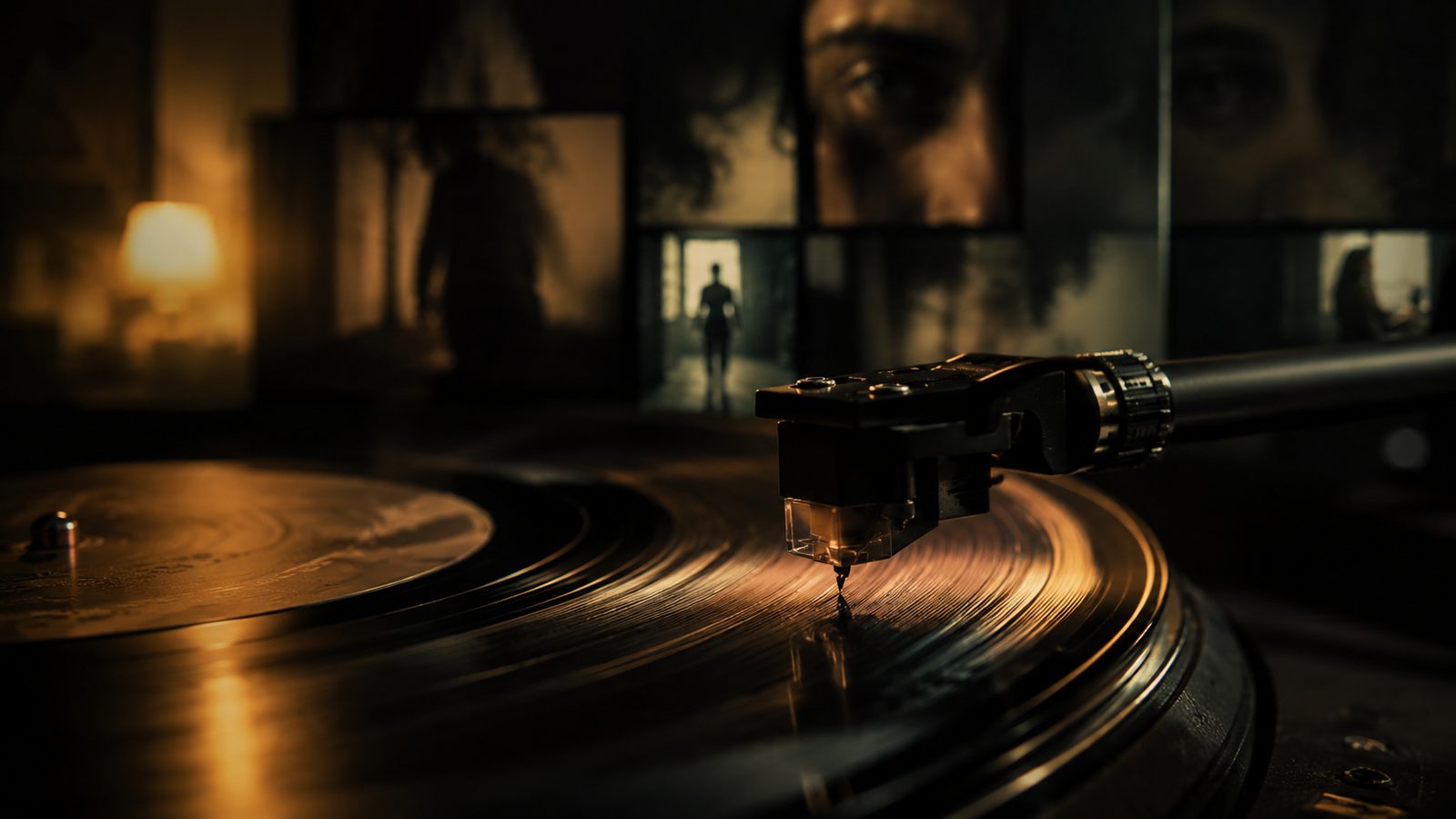
A tonearm descending toward a spinning record in extreme close-up — the most replicated turntable shot in film school history.
The scene
In the "Summer" sequence of Requiem for a Dream, Harry and Tyrone are riding high. Life is good, money is flowing, and the future feels infinite. Aronofsky marks these moments with a kinetic montage that would become his signature: rapid-fire close-ups of pupils dilating, drugs hitting bloodstreams, cash being counted — and a turntable needle dropping into a groove.
The needle-drop isn't just set dressing. It's perfectly synchronized with Clint Mansell and the Kronos Quartet's hypnotic score. The tonearm descends in extreme close-up — you can see the diamond stylus approaching the record's surface in almost painful detail. Then contact. The groove catches. And the sequence launches forward.
The shot repeats throughout the film, each time carrying slightly different weight. In summer, it's euphoric. By winter, the same gesture feels desperate. The turntable doesn't change — but what it means does.
The gear
The specific turntable in Harry's Brooklyn apartment has never been conclusively identified — it's filmed in such extreme close-up that brand identification is nearly impossible. What's visible is a standard direct-drive or belt-drive turntable with a straight tonearm, likely a consumer model from the 1980s or 1990s.
But the gear isn't the point. Aronofsky uses the needle drop as a cinematic device — the physical act of a stylus meeting vinyl becomes shorthand for initiation, commitment, the moment of no return. It's the same gesture every time: the tonearm lifts, swings, descends. Contact. Consequence.
This specific close-up angle — tonearm descending at roughly 45 degrees, shallow depth of field, amber sidelight — became arguably the most imitated turntable shot in independent cinema. Film students have been recreating it for twenty-five years.
"Juice by Tappy! Juice by Tappy!"
— Harry Goldfarb, during the montage sequences
Why it matters
Requiem for a Dream didn't invent the turntable close-up, but it perfected it as a narrative device. The needle-drop montage has been studied, dissected, and replicated in film schools worldwide. It proved that the physical mechanics of vinyl playback — tonearm, stylus, groove — are inherently cinematic.
There's a reason this works: a turntable needle-drop is one of the few moments in audio playback that's visually dramatic. You can see the action. You can anticipate the sound. The gap between the stylus and the groove is pure tension — and the moment of contact is pure release. Aronofsky understood this instinctively.
The film also reinforced the turntable as cultural shorthand for a certain kind of urban authenticity. Harry's apartment is sparse, but he has a turntable and records. The gear isn't aspirational — it's personal. It's the sound of his life, on repeat, until the record runs out.
Affiliate disclosure: We may earn a commission from qualifying purchases made through links on this page, at no extra cost to you.
Audio-Technica AT-LP120X
~$250Direct-drive turntable with a straight tonearm — the closest match to the Requiem aesthetic. Perfect for recreating that needle-drop shot.
View on AmazonTechnics SL-1500C
~$1,200Premium direct-drive with Technics engineering. The tonearm descent on this turntable is as cinematic as it gets outside a Darren Aronofsky film.
View on AmazonPro-Ject Debut Carbon EVO
~$500Carbon-fiber tonearm with exceptional tracking. The kind of precision that makes every needle drop feel like the opening shot of a movie.
View on Amazon