The Sony Portapak in The Velvet Underground
The camera that democratized video. The band that democratized noise. Todd Haynes connected them with footage nobody knew existed.
The Scene
Todd Haynes's 2021 documentary The Velvet Underground is built on a radical formal idea: rather than relying on talking heads and concert footage, the film immerses the viewer in the visual language of the 1960s New York underground. Split screens, experimental film, and — most strikingly — grainy black-and-white video footage that captures the band's world with an intimacy that 16mm film couldn't match.
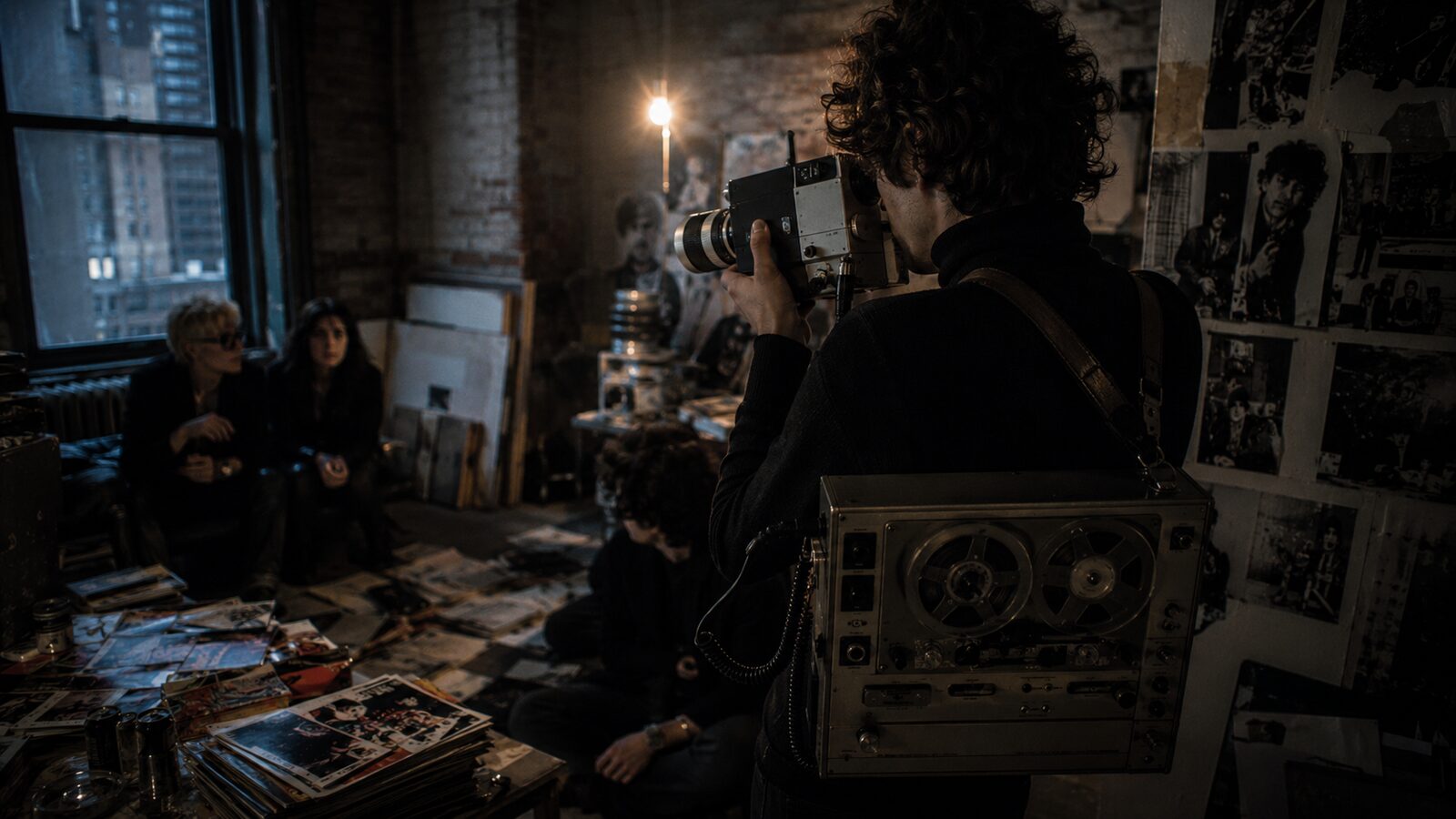
That footage was shot on a Sony Portapak, the first portable video recording system available to consumers. Archival consultant Steve Nelson provided the key footage, shot in 1970 using what he described as "my friend Michael Pitkow's video gear, a primitive Sony Portapak." The resulting recordings — including footage of the band performing "Candy Says" — had sat unseen for decades before Haynes incorporated them into the documentary.
The Portapak footage feels fundamentally different from the film-based material surrounding it. It's lower resolution, more immediate, more voyeuristic — you're not watching a performance, you're eavesdropping on one. That quality made it the perfect visual metaphor for Haynes's thesis: that the Velvet Underground existed in the spaces between high art and low technology.
The Gear
The Sony Portapak (officially the Sony DV-2400 video recorder with AVC-3400 camera) was introduced in 1967 as the first truly portable video recording system. It consisted of a handheld camera tethered by cable to a separate reel-to-reel video tape recorder, worn on a shoulder strap. The system recorded on half-inch open-reel video tape and produced black-and-white footage at a quality that, by broadcast standards, was terrible — but by accessibility standards, was revolutionary.
Before the Portapak, video recording required a studio, a crew, and tens of thousands of dollars in equipment. The Portapak put video into the hands of artists, activists, and documentarians for under $1,500. It was adopted by the Fluxus art movement, by guerrilla television collectives like TVTV and Videofreex, and by individual artists like Nam June Paik and Joan Jonas.
The Portapak's connection to the Velvet Underground isn't just incidental — it's cultural. Both the band and the camera emerged from the same downtown New York ecosystem of the late 1960s, where accessibility and experimentation mattered more than polish. The Portapak was the VCS3 of video: a tool that let non-professionals create work that professionals couldn't imagine.
Using my friend Michael Pitkow's video gear, a primitive Sony Portapak, I shot some grainy black-and-white footage Todd was able to use.— Steve Nelson, archival consultant for The Velvet Underground
Why It Matters
The Sony Portapak's cultural significance extends far beyond one documentary. It essentially created the medium of video art, enabled the rise of independent documentary, and established the aesthetic of lo-fi intimacy that persists through YouTube, TikTok, and every smartphone video ever shot. When people talk about the "democratization of media," the Portapak is where that story begins.
On the collector market, original Portapak systems appear on eBay in the $500–$1,500 range, though finding one in working condition with compatible tape stock is increasingly difficult. They're collected as art objects and technological artifacts rather than functional tools. The related Sony AV-3400 (a later, improved model) commands similar prices.
For anyone interested in the lo-fi video aesthetic without the maintenance burden, modern cameras with analog-style processing — or even smartphone apps that simulate the Portapak look — can approximate the feel. But nothing quite matches the original: the mechanical whir of the tape transport, the warmth of the tube-based camera, the knowledge that you're holding the tool that started it all.
The Gear Cards
Sony Portapak (DV-2400 + AVC-3400)
The first portable consumer video recording system. Half-inch open-reel tape, B&W camera, shoulder-slung recorder. The tool that created video art.
Sony AV-3400
Improved successor Portapak model with better tape handling and image stability. Same basic concept — camera + portable recorder — in a more refined package.
Modern Alternatives
Blackmagic Pocket Cinema 6K
Modern cinema camera that can emulate vintage video looks with the right LUTs and settings. Professional quality at an indie price point.
View on AmazonElgato Cam Link 4K
Capture device that connects vintage cameras to modern recording systems. Bridge old and new video worlds.
View on AmazonSuper 8 Camera (various)
Vintage film cameras that produce the same lo-fi aesthetic as the Portapak. Kodak still manufactures Super 8 film stock.
View on Amazon