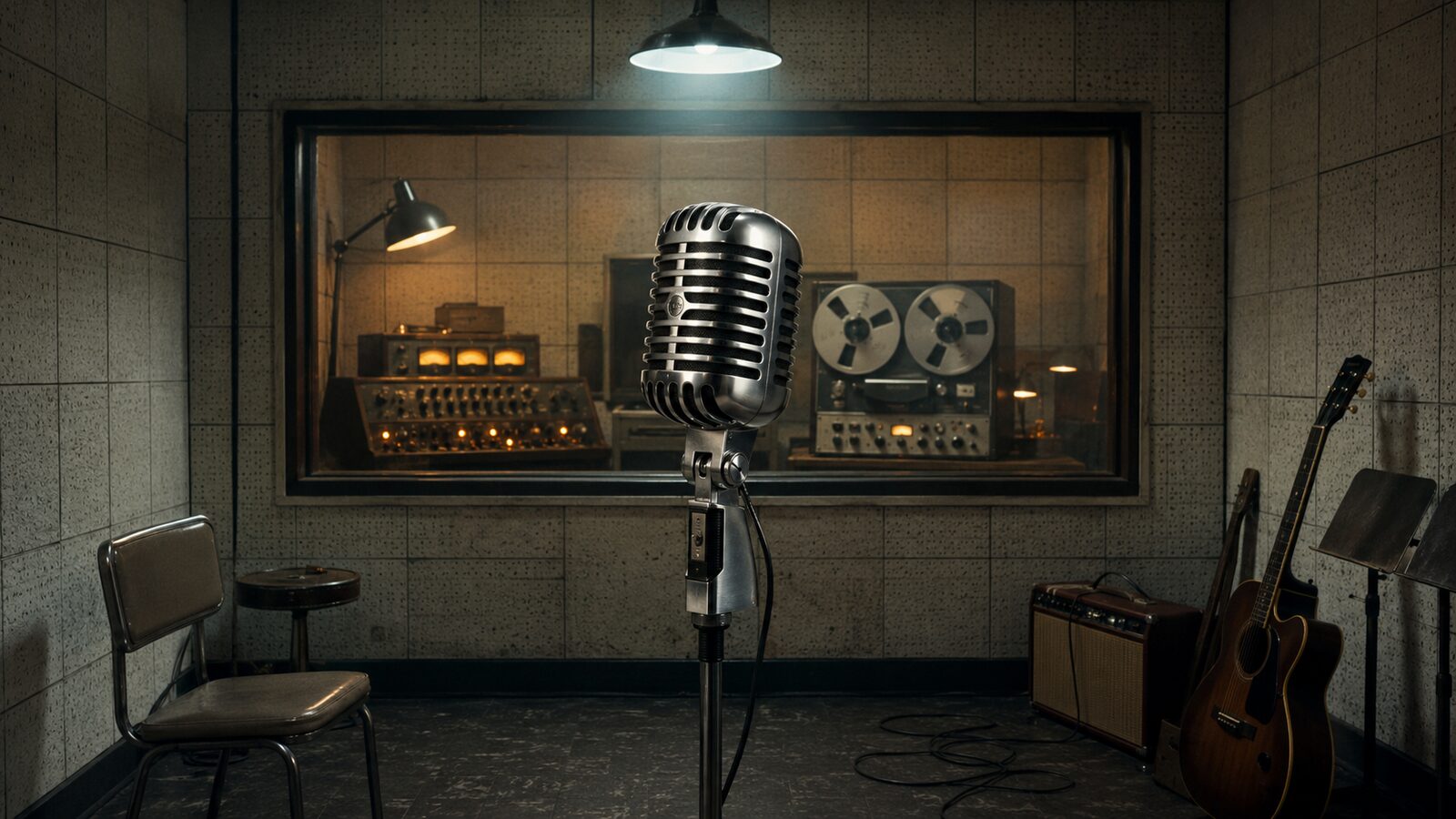
Memphis, 1955. A small, plain recording studio at 706 Union Avenue — Sun Records. The room is modest: acoustic tiles on the walls, a single hanging light, a microphone in the middle of the floor. But that microphone is a chrome Shure 55 — one of the most visually iconic pieces of audio equipment ever made — and the man behind the glass in the tiny control room is Sam Phillips, who is about to change the world.
Walk the Line depicts the moment Johnny Cash walked into Sun Records and auditioned for Phillips. The studio was meticulously recreated for the film, down to the specific models of equipment Phillips used. Through the control room window, an Altec 1567A mixer and an Ampex 350 reel-to-reel tape machine are visible — the exact tools that captured the earliest recordings of Elvis Presley, Jerry Lee Lewis, Carl Perkins, and Cash himself.
The scene is electric precisely because the room is so ordinary. This isn't Abbey Road or Electric Lady. It's a storefront with egg cartons on the walls. But the equipment in it — and the ear of the man operating it — created the template for rock and roll.
The Shure 55 (also called the Shure Unidyne or "Elvis mic") is one of the most recognizable microphones in history. Its chrome, art-deco design made it visually iconic before anyone heard a word through it. Introduced in 1939, the Shure 55 was the first single-element unidirectional microphone, meaning it picked up sound from the front while rejecting noise from the sides and back. This was revolutionary for live performance and recording, and its distinctive shape became synonymous with the golden age of rock and roll.
The Altec 1567A mixer was Sam Phillips' primary mixing console at Sun Records. A simple five-channel tube mixer, it provided the warm, slightly overdriven sound that characterized the Sun Records catalog. Phillips used it to blend vocals and instruments in real time, often pushing the tubes into gentle distortion to create the "slapback echo" that became the signature Sun Records sound.
The Ampex 350 reel-to-reel tape machine recorded the performances to magnetic tape. Phillips' technique of using the Ampex's playback head to create a slight delay — feeding the signal back to create echo — was one of the most important innovations in recording history. That echo is the sound of Sun Records, and it was created entirely through creative use of the equipment's physical properties.
If you was hit by a truck and you was lying out there in that gutter dying, and you had one time to sing one song — one song that people would remember before you're dirt — one song that would let God know how you felt about your time here on Earth — one song that would sum you up... you telling me that's the song you'd sing?— Sam Phillips to Johnny Cash, Walk the Line
Walk the Line grossed $186 million and won Reese Witherspoon the Academy Award for Best Actress. But for gear enthusiasts, the film's most important contribution is its meticulous recreation of Sun Records — the studio where rock and roll, rockabilly, and modern country music were essentially invented between 1953 and 1957.
The Shure 55 microphone, the visual centerpiece of the film, sells for $100 to $400 on the vintage market depending on era and condition. Shure still manufactures a modern version, the 55SH Series II, for about $250. The Altec 1567A mixer is a serious collector's item at $1,500 to $4,000. The Ampex 350 tape machine — the workhorse that captured those early sessions — goes for $500 to $2,000.
What makes this entry essential is the simplicity. Sam Phillips created the most influential recordings in American popular music history with a five-channel mixer, a tape machine, and a microphone. No overdubs, no effects racks, no automation. Just a room, the gear, and the artists. The equipment at Sun Records proves that revolutionary sound doesn't require revolutionary technology — it requires revolutionary ears.
Affiliate disclosure: We may earn a commission from qualifying purchases made through links on this page, at no extra cost to you.
The 'Elvis mic.' Chrome art-deco design, first single-element unidirectional microphone. The visual and sonic icon of 1950s recording and the birth of rock and roll.
Sam Phillips' five-channel tube mixer at Sun Records. The warm, slightly overdriven sound that defined rockabilly, early rock and roll, and the slapback echo heard on every Sun Records hit.
Modern reissue of the iconic Shure 55. Same chrome art-deco design with updated internals. Looks exactly like the original, sounds even better.
View on Amazon →USB audio interface with built-in vintage preamp emulation. Captures the warm, tube-adjacent character that made Sun Records sound like Sun Records.
View on Amazon →Modern analog-style mixer with multitrack recording. The closest modern equivalent to a simple, hands-on console like the Altec 1567A.
View on Amazon →As an Amazon Associate we earn from qualifying purchases.