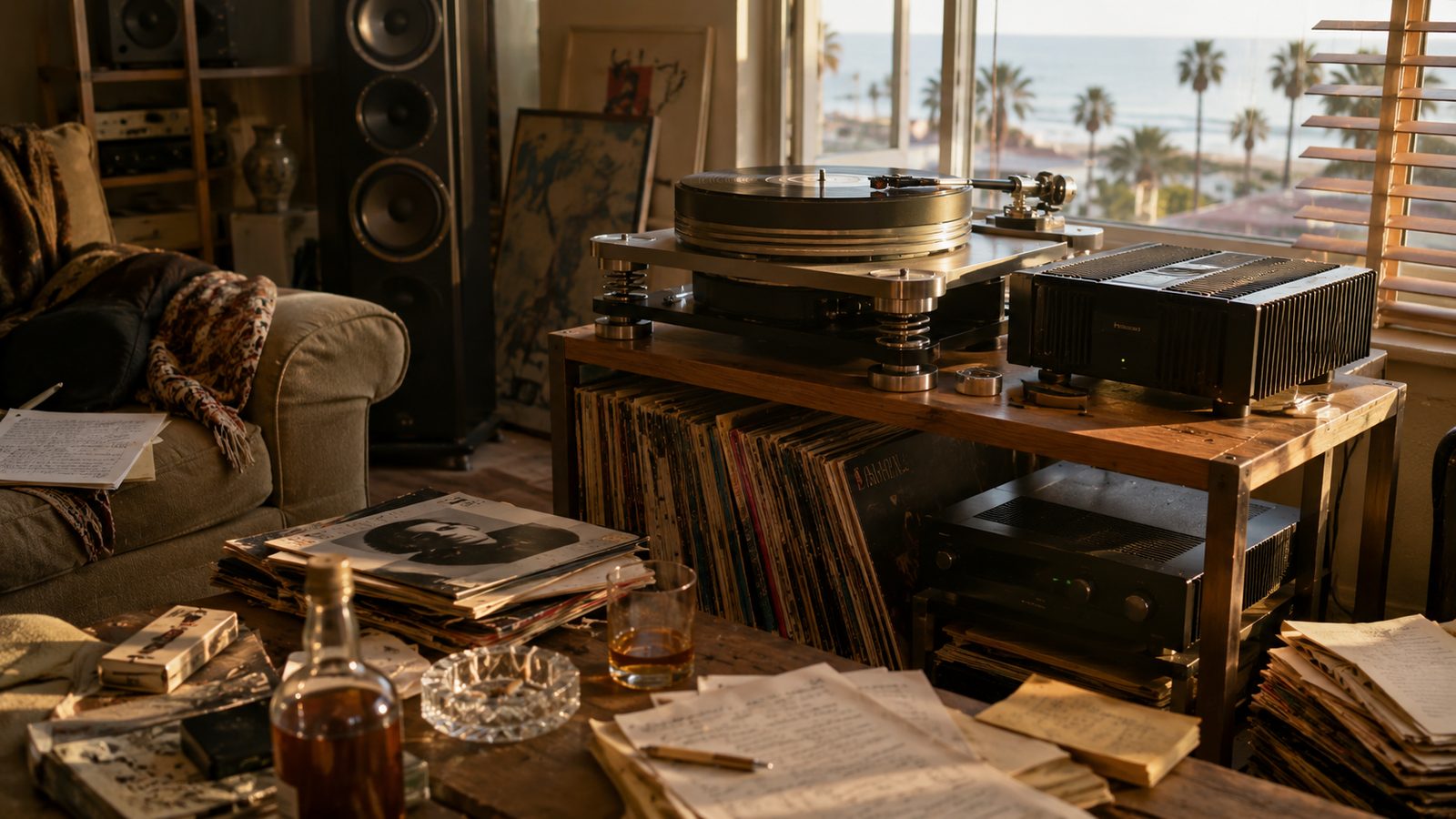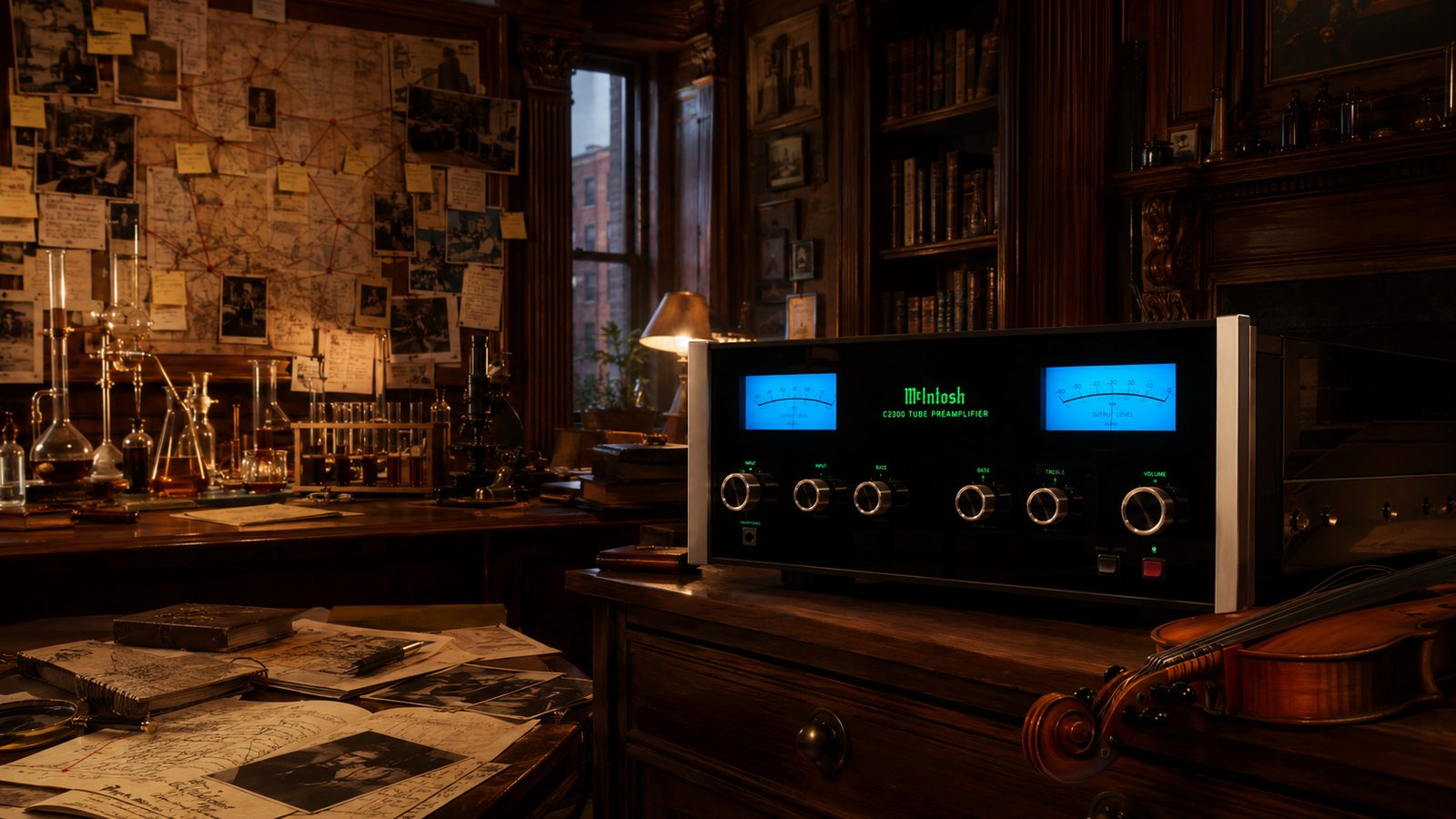
Hank Moody — novelist, alcoholic, hopeless romantic living in Venice Beach — keeps an Avid turntable and Krell amplifier surrounded by whiskey bottles, crumpled manuscript pages, and scattered vinyl records. Sherlock Holmes — consulting detective, recovering addict, eccentric genius living in a Manhattan brownstone — has a McIntosh C2300 preamplifier sitting among chemistry equipment, case files, and a violin.
Both men are brilliant. Both are self-destructive. Both use music not as entertainment but as a necessary component of their cognitive process. Moody writes to music. Holmes thinks to music. The gear they chose tells you everything about how their minds work.
The Moody rig: Avid + Krell in creative chaos
Avid turntables are British-made, precision-engineered, and designed for listeners who believe the turntable is the most important component in the chain. They're not flashy — they're obsessive about isolation, speed stability, and mechanical precision. Paired with a Krell amplifier (known for massive power reserves and a detailed, unforgiving sound signature), Moody's system is built to deliver music with absolute clarity.
The contradiction is the environment. This is a system that demands a quiet, treated room to perform at its best — and it lives in a Venice Beach bungalow with open windows, traffic noise, and God knows what else. Moody doesn't care. The system exists because the music matters, not because the conditions are perfect. That's very Hank Moody.
Avid turntables run $2,000–$10,000+ depending on model. Krell amplifiers range from $1,000–$5,000+ on the used market. This is easily a $5,000–$15,000 system living in a room that deserves about $500 worth of speakers.
The Holmes rig: McIntosh precision
The McIntosh C2300 preamplifier in the brownstone is pure Sherlock. It's a vacuum tube preamp with McIntosh's iconic black glass faceplate, green illuminated logo, and blue VU meters. It's both beautiful and functional — a piece of audio jewelry that also happens to be one of the finest preamps ever made.
The C2300 uses twelve vacuum tubes in its audio circuit, delivering a warm, rich signal with the kind of detail and separation that would appeal to someone who listens to a recording the way they'd examine a crime scene — noticing every layer, every anomaly, every hidden element. Holmes would hear things in a recording that other people miss. The C2300 would let him.
On the used market, the McIntosh C2300 sells for $3,000–$5,000. It's a single component — we don't see the full system in the show — but it's the control center, and it tells you everything about the listener's priorities: precision, warmth, and beauty in equal measure.
Moody's system is high-end gear in a low-end room. Holmes's system is high-end gear in a high-end room used for low purposes. Both are perfectly wrong in exactly the right way.
The verdict
Holmes wins on the component level. The McIntosh C2300 is a more refined, more celebrated piece of equipment than anything we can specifically identify in Moody's chain. McIntosh carries a prestige and a resale value that even Krell can't match.
But Moody wins on commitment. He has a full system — turntable, amplification, speakers — and he uses it constantly. Music isn't a background detail for Hank Moody; it's the organizing principle of his life. Holmes has a preamp (gorgeous, admittedly) sitting on a desk next to a violin and some beakers. We're not convinced he listens as often as Moody does.
Final call: Moody. The man who listens hardest wins.