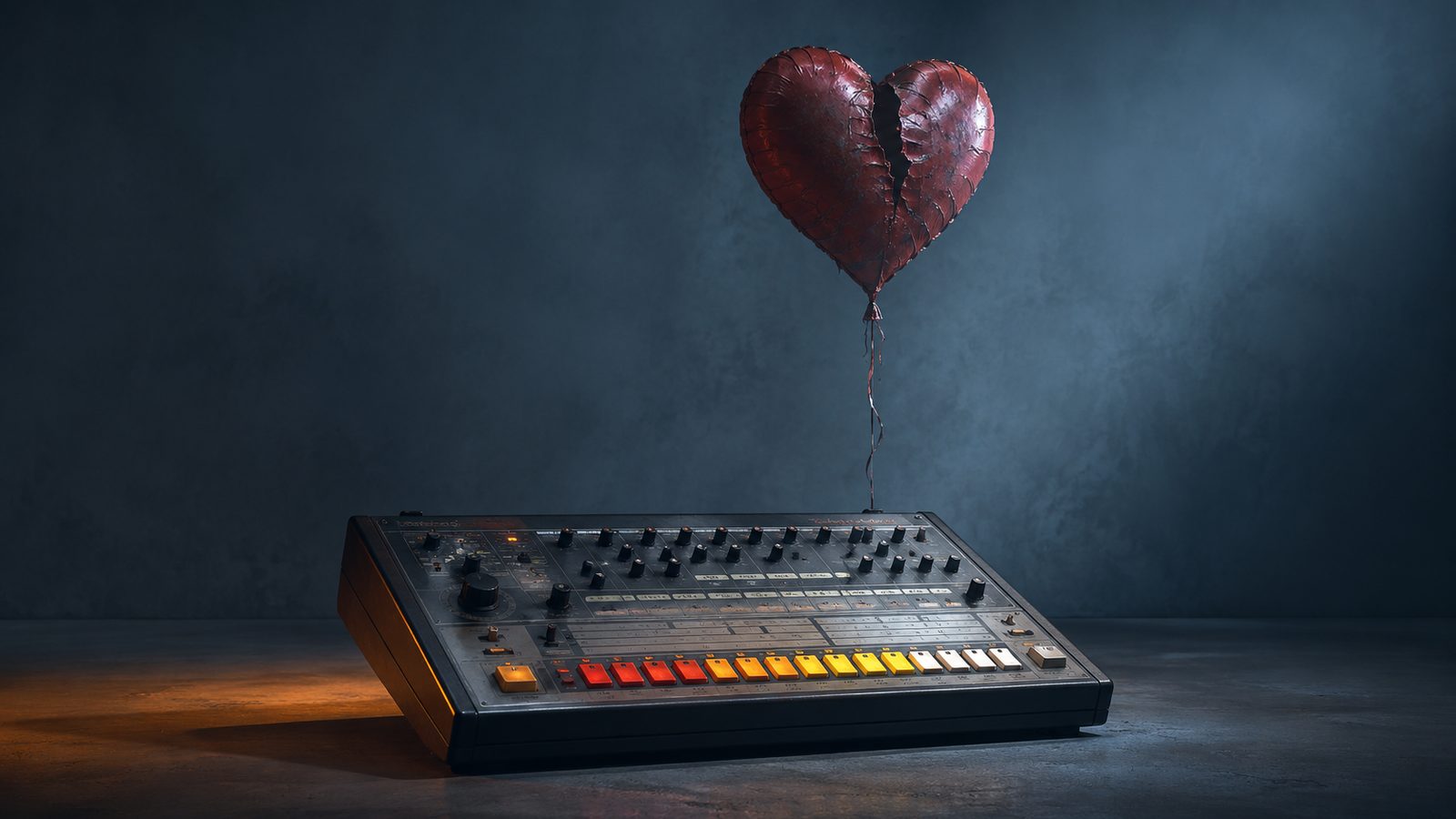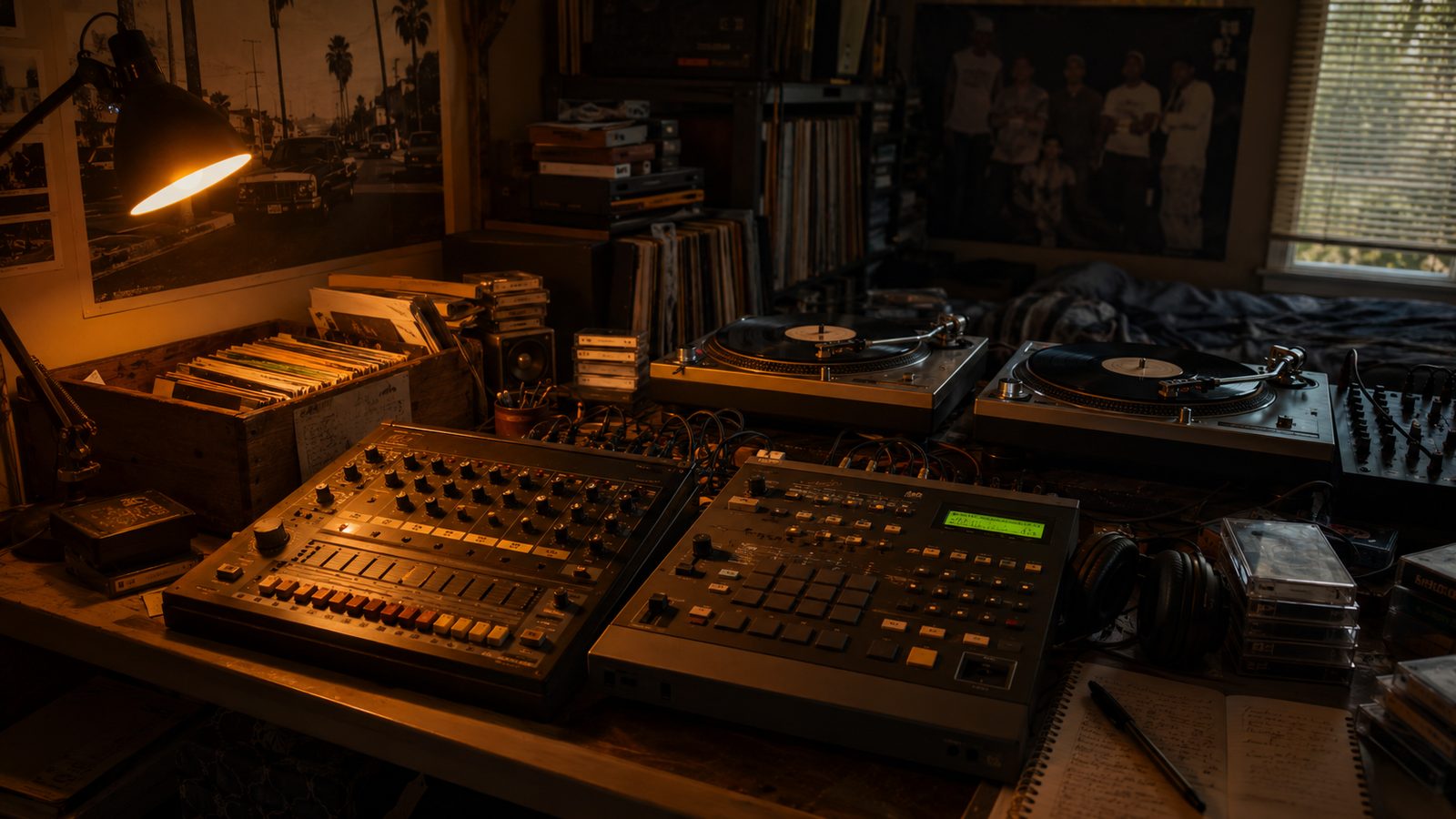
If you've listened to any hip-hop, house, trap, or pop song recorded in the last four decades, you've heard the Roland TR-808. Its booming bass drum rattles car speakers from Atlanta to Tokyo. Its crisp handclap and sizzling hi-hats are so deeply embedded in modern production that most listeners don't even notice them anymore — the way you stop noticing the hum of electricity. The 808 isn't just a drum machine. It's the rhythmic foundation of contemporary music.
Which makes it all the more remarkable that Roland considered it a failure.
A clock repairman's dream machine
The story of the TR-808 starts with Ikutaro Kakehashi, a Japanese entrepreneur who spent his youth repairing clocks, radios, and organs in postwar Japan. He founded the Ace Tone company in 1960, building rhythm accompaniment machines for Hammond organs. By 1972 he had started Roland Corporation, and over the next several years the company released a string of rhythm devices — most notably the CR-78 CompuRhythm in 1978, one of the first programmable drum machines.
But Kakehashi wanted something more flexible. He envisioned a machine that would let musicians program entire percussion tracks from scratch — complete with breaks, rolls, and fills — rather than cycling through canned preset patterns. The result was the TR-808 Rhythm Composer, released in 1980 at a retail price of $1,195 (roughly $4,400 in today's dollars).
The "TR" stood for Transistor Rhythm. And it was those transistors that would define everything the 808 became.
The beautiful accident
Unlike its main competitor, the Linn LM-1 (which used digitally sampled recordings of real drums and cost nearly $3,000), the 808 generated all of its sounds through analog synthesis — electrical circuits that produced waveforms shaped into drum-like tones. The specific circuits in the 808 relied on a batch of transistors that didn't meet manufacturer specifications. They were, technically, defective parts.
Those "faulty" transistors gave the 808 its character. The bass drum didn't sound like a bass drum — it was a deep, sub-frequency boom with a long, tunable decay. The snare had an electronic sizzle. The cowbell was synthetic and sharp. The handclap sounded like a room full of people clapping, run through a lo-fi filter. Nothing about the 808 sounded real, and that was precisely the complaint.
Everything was 'wrong' with the 808. It was destined for failure. It didn't sound right, it didn't sound like a drum, two 808s didn't sound alike. All the critics called it a complete UFO of studio equipment. — Alex Noyer, producer of the documentary 808
Producers in 1980 wanted realistic. They wanted the convincing snare crack and hi-hat shimmer of the Linn. The 808's synthetic textures felt toy-like by comparison. Reviews were lukewarm. Sales were slow.
Then the transistors ran out. As semiconductor manufacturing improved through the early 1980s, factories got better at producing consistent, defect-free parts. The specific flawed components that gave the 808 its sound simply stopped being available. Roland couldn't source replacements. In 1983, after building approximately 12,000 units, they pulled the plug and replaced it with the sample-based TR-909.
The 808 was dead. Kakehashi's Rhythm Composer had lasted just three years.
The $100 drum machine that changed everything
What happened next is one of the great second-act stories in music technology. As the 808 disappeared from store shelves, established musicians began dumping theirs on the used market. Prices cratered. By the mid-1980s, a working TR-808 could be found in pawn shops and music stores for under $100 — less than a tenth of its original retail price.
That price point put it directly in the hands of the people who would change music forever: broke, hungry, inventive artists working in bedrooms, basements, and project studios. Hip-hop producers. Chicago house DJs. Detroit techno pioneers. Electro experimenters. They didn't care that the 808 sounded "unrealistic." They loved it because it sounded like nothing else.
- 1980 Yellow Magic Orchestra uses the 808 on BGM — among the first recordings to feature the machine. Roland credits their live performance of "1000 Knives" as the first live 808 use.
- 1982 Marvin Gaye records "Sexual Healing" with an 808 groove — the song that introduced the machine's sound to mainstream R&B. That same year, Afrika Bambaataa releases "Planet Rock," fusing 808 beats with Kraftwerk-inspired synths and inventing electro.
- 1983 Roland discontinues the 808. Hashim's "Al-Naafiysh (The Soul)" pushes the 808 deeper into New York's hip-hop and electro scenes.
- 1986 The Beastie Boys release Licensed to Ill, with "Paul Revere" built on a reversed 808 pattern. Run-DMC, LL Cool J, and Public Enemy are all deep into 808 production.
- 1987 Whitney Houston's "I Wanna Dance with Somebody" uses an 808 — proving the machine works in pure pop as well as hip-hop and electronic music.
- 1988–1992 Chicago house and Detroit techno artists build entire genres around 808 and 909 patterns. The machine's sounds become the rhythmic DNA of electronic dance music worldwide.
- 2008 Kanye West releases 808s & Heartbreak, an album named after the machine. The album's stark, emotional production helps launch the next wave of 808-driven music — from Drake's melodic rap to the entire trap genre.
- 2010s–present The term "808" becomes shorthand for a deep bass drum in hip-hop production. The sound dominates trap music via producers like Lex Luger, Metro Boomin, and Zaytoven. Original units sell for $4,000–$6,000+.
Why the 808 won
The TR-808's dominance wasn't an accident — it had three structural advantages that no competitor could replicate.
It was programmable. The 808 was one of the first drum machines to let users create original patterns from scratch using its 16-step sequencer with sub-step divisions. Earlier machines offered preset rhythms — bossa nova, waltz, rock. The 808 let you build whatever you heard in your head, one step at a time. For hip-hop producers building beats that didn't exist in any preset library, this was everything.
It was tuneable. Each sound could be shaped. The bass drum's decay could be extended into a deep, sustained sub-bass tone — a capability that would become the defining sonic signature of entire genres, from Miami bass to modern trap. Turn the decay knob up and the kick stops being a drum hit; it becomes a bass note. That single parameter change invented a sound.
It was cheap. After discontinuation, the 808 was the most affordable serious drum machine on the used market. It ended up in the hands of exactly the artists who had the most to say and the least to spend. The Fender Stratocaster analogy gets used a lot, and it's apt: like the Strat, the 808's affordability and versatility put it at the center of a creative revolution.
The 808 in pop culture
The TR-808 has crossed over from studio tool to cultural icon in ways that no other piece of audio equipment has matched. Kanye West named an album after it. The 2015 documentary 808 traced its impact from Marvin Gaye through Pharrell Williams and Lil Wayne. The machine's colorful button layout — red, orange, yellow, white squares arrayed across a silver faceplate — is one of the most recognizable silhouettes in music technology, printed on t-shirts, tattooed on forearms, and hung as art on studio walls.
Across our own "As Seen In" pages, the 808 appears directly in the Kanye "808s & Heartbreak" feature, and its influence echoes through the production setups in N.W.A / Straight Outta Compton, 8 Mile, and LL Cool J's "Radio." Every one of those artists built their sound on the machine Roland gave up on.
The collector market today
Original TR-808 units are now serious collector's items. Working examples in good cosmetic condition typically sell for $4,000 to $6,000 on eBay and Reverb, with mint-condition or historically notable units occasionally listed for $10,000 or more. The irony is inescapable: a machine that Roland sold for $1,195 and that was going for under $100 in the mid-1980s is now worth five to fifty times its original retail price.
The market is driven by a mix of working producers who want the analog original and collectors who treat the 808 as a piece of music history. Condition matters enormously — original knobs, intact button pads, and a clean faceplate all command premiums. Serviced units with recapped power supplies and calibrated circuits sell fastest.
For most producers, though, the original isn't necessary. Roland and others have released faithful recreations that deliver the sound without the five-figure price tag.