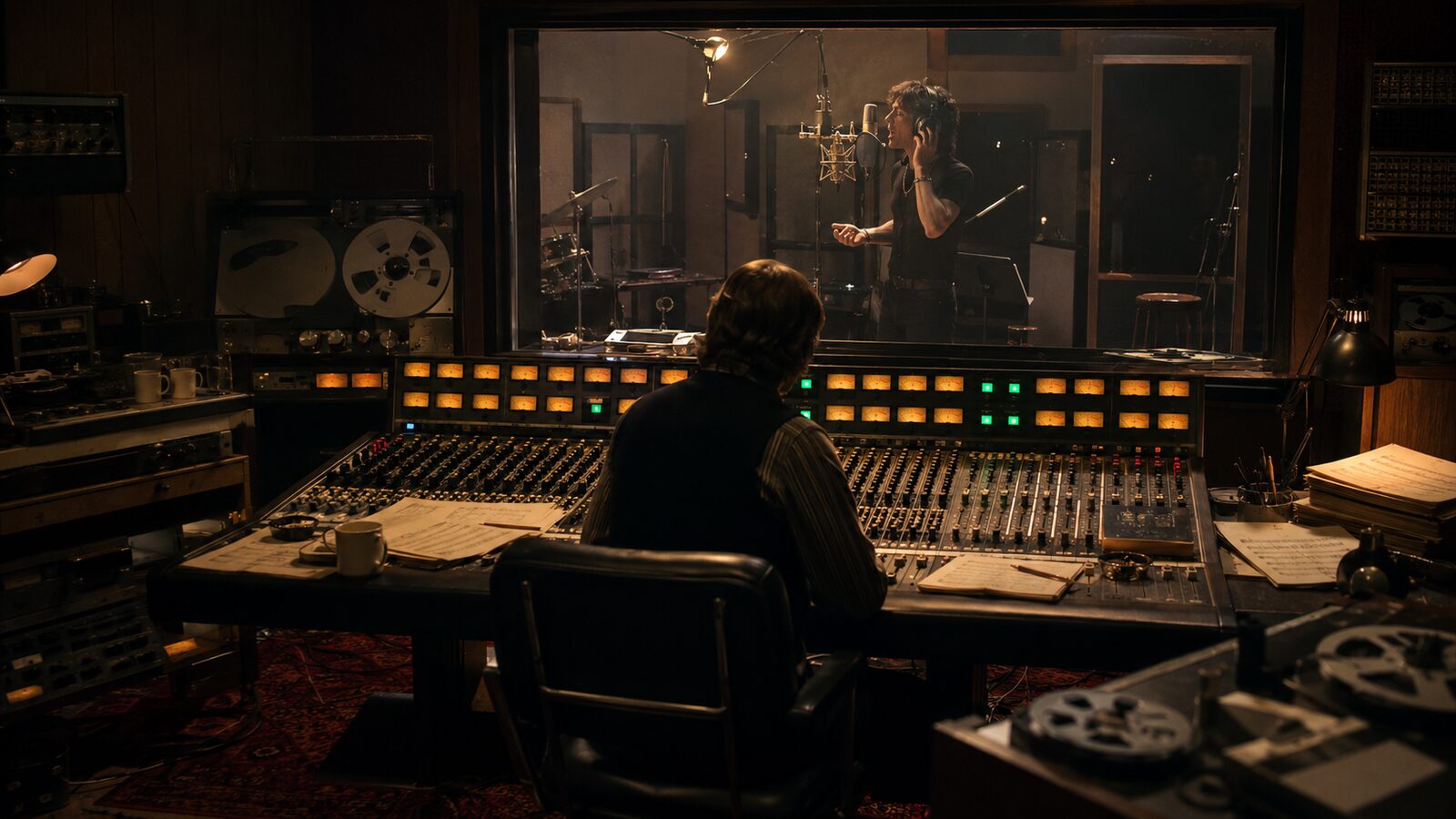
Rockfield Studios, Wales, 1975. A massive mixing console stretches across the control room — dozens of faders, knobs, and VU meters glowing amber and green. A Studer multi-track tape machine spins behind the engineer's chair, its reels turning slowly. Through the control room glass, a vocalist stands at a Neumann U87 microphone, headphones on, arms outstretched, singing with the intensity of someone who knows what he's creating will outlive everyone in the room.
The recording sequence for the song "Bohemian Rhapsody" is the film's centerpiece — and one of the most gear-intensive scenes in modern music cinema. The scene shows the painstaking process of building a six-minute rock opera in an era before digital editing: recording vocal overdubs onto tape, bouncing tracks, pushing the Studer machine to its physical limits. At one point, the tape becomes so thin from repeated passes that it's nearly transparent.
The film earned over $900 million worldwide and won Rami Malek the Academy Award for Best Actor. But for audio enthusiasts, the recording sequences are the real star — a detailed, visceral depiction of analog recording at its most ambitious.
The Trident mixing console recreated in the film represents the type of British console that defined the sound of 1970s rock. Trident Studios in London — where Queen actually recorded their early albums — was famous for its custom A-Range console, and Rockfield Studios in Wales (where the real "Bohemian Rhapsody" was tracked) had its own Trident desk. These hand-wired British consoles had a warmth, depth, and harmonic richness that modern digital consoles have spent decades trying to emulate.
The Studer A800 multi-track tape machine was the workhorse of professional recording studios from the mid-1970s through the 1990s. Its 24-track format on two-inch tape gave engineers the ability to record instruments and vocals on separate tracks for independent mixing — but with a fixed number of tracks, every recording decision was permanent. The film dramatizes the physical limitations beautifully: you can hear the tape degrading with each pass.
The Neumann U87 microphone — visible in the vocal booth scenes — is one of the most widely used studio condenser microphones in recording history. Its detailed, transparent sound captures vocal nuance with surgical precision, and its distinctive grille shape is instantly recognizable to anyone who's spent time in a professional studio.
I want to give the audience a song that they can perform.— Freddie Mercury, as depicted in Bohemian Rhapsody
The song "Bohemian Rhapsody" required an estimated 180 separate vocal overdubs — all recorded onto magnetic tape. The operational section alone features three-part harmonies stacked multiple times, with each layer requiring a precise performance and a physical tape bounce. No copy-paste, no pitch correction, no undo button. Every take that was recorded over was gone forever.
On the vintage market, Studer A800 tape machines are serious collector's items at $5,000 to $25,000 depending on condition and head wear. Neumann U87 microphones sell for $2,000 to $4,000, and are still in production at around $3,200 new. Vintage Vox AC30 amplifiers — the guitar amp of choice for Brian May — go for $800 to $2,000.
The film's recording sequences are a masterclass in what analog recording demanded: precision, commitment, and the understanding that every note was being carved into a physical medium. In a world where digital recording offers infinite takes and unlimited tracks, the constraints that the Rockfield sessions operated under feel almost heroic.
Affiliate disclosure: We may earn a commission from qualifying purchases made through links on this page, at no extra cost to you.
The hand-wired British console that defined 1970s rock. Warm, harmonically rich preamps and EQ sections that gave Queen, David Bowie, and Elton John their recorded sound.
The most iconic studio condenser microphone in recording history. Transparent, detailed, and present — the default vocal microphone for five decades of professional recording.
Ultra-low-noise studio condenser microphone with the clarity and detail of mics costing ten times more. The modern affordable alternative to the U87.
View on Amazon →Desktop audio interface with Unison preamp technology and built-in UAD plugins, including tape machine and console emulations.
View on Amazon →Modern single-speaker version of the iconic AC30. The chimey, articulate tone that defined Brian May's guitar sound and British rock.
View on Amazon →As an Amazon Associate we earn from qualifying purchases.