The Yamaha DX7 on Brian Eno's Apollo
The most common synthesizer on earth, used to soundtrack the most extraordinary footage ever recorded. Eno made the DX7 sound like outer space.
The Scene
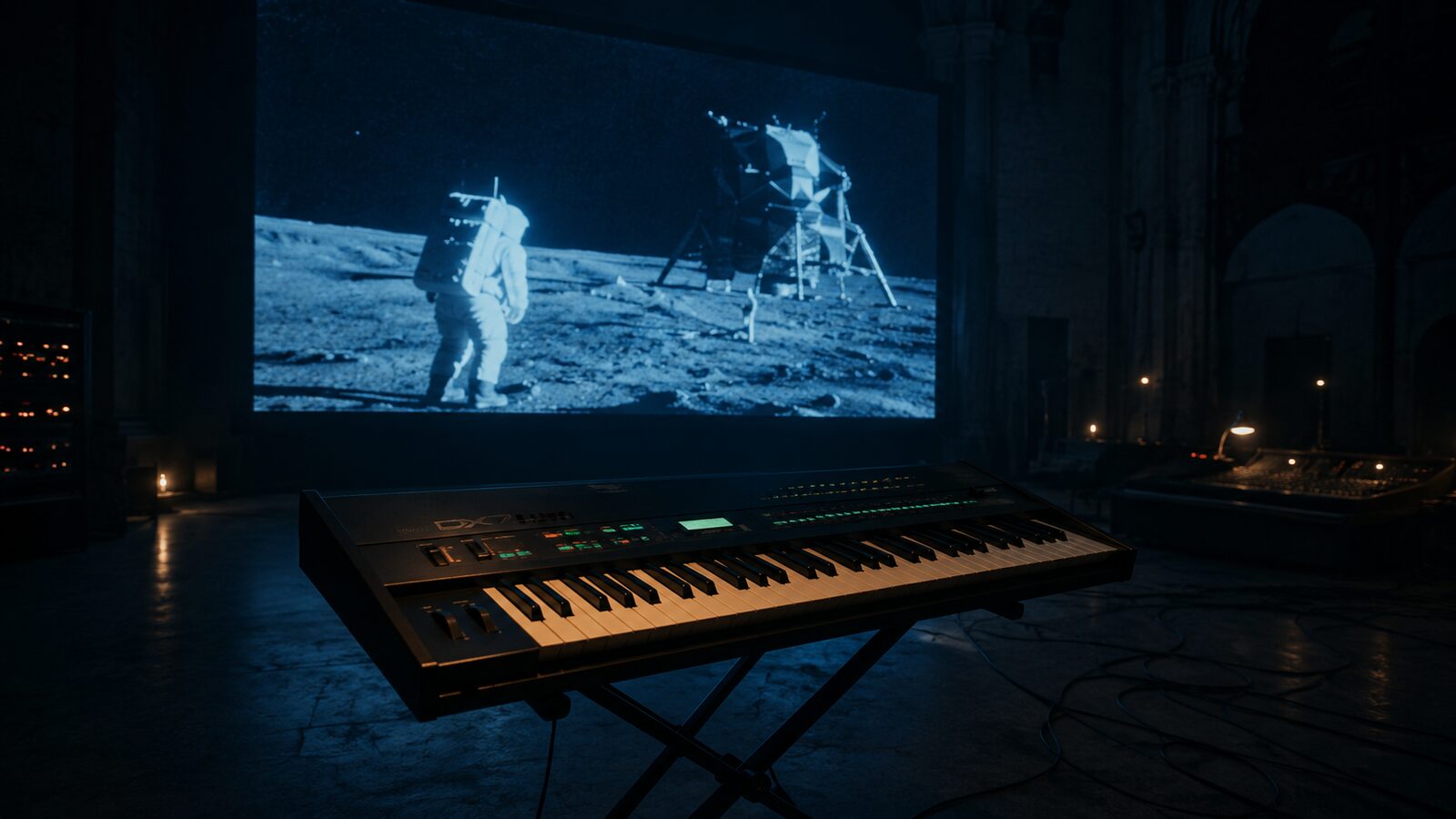
Apollo: Atmospheres & Soundtracks was commissioned to accompany Al Reinert's documentary For All Mankind, which assembled NASA footage from the Apollo missions into a single narrative of lunar exploration. Eno, working with his brother Roger Eno and Daniel Lanois, needed to create music that matched the scale of the imagery — the silence of space, the desolation of the lunar surface, the fragile beauty of Earth seen from orbit.
He reached for the Yamaha DX7, the FM synthesis keyboard that had just been released in 1983 and was rapidly becoming the most commercially successful synthesizer in history. The DX7 was everywhere by the mid-1980s — in pop, in jazz fusion, in commercial jingles, in church worship bands. It was, by any measure, the most ordinary synth of its era. Eno made it sound like nothing on Earth.
The album's signature textures — shimmering, glassy pads that seem to hover in zero gravity — are DX7 patches processed through Eno's characteristic treatments: long reverb tails, subtle pitch modulation, and multi-tracked layering that turns a single keyboard into an orchestra of overtones. Tracks like "Deep Blue Day" (later used in Trainspotting) and "An Ending (Ascent)" have become some of the most recognizable pieces of ambient music ever composed.
The Gear
The Yamaha DX7, released in 1983, was the world's first commercially successful digital synthesizer. It uses FM (Frequency Modulation) synthesis — a method where one oscillator modulates the frequency of another, creating complex harmonic spectra from simple waveforms. The DX7 has six operators (oscillators) that can be arranged in 32 different algorithms, producing everything from glassy electric pianos to metallic bells to otherworldly pads.
Over 200,000 DX7 units were sold, making it one of the best-selling synthesizers of all time. Its distinctive sounds — the electric piano patch, the marimba, the breathy pad — defined 1980s pop. But Eno's use of the DX7 on Apollo demonstrated that the instrument could transcend its commercial reputation. By programming custom patches and processing them through external effects, he extracted textures from the DX7 that most users never knew it could produce.
Daniel Lanois, who co-produced and performed on the album, has noted that the sessions were remarkably sparse — Eno, Roger Eno, and Lanois working with a small set of instruments in a controlled environment, building layers slowly and deliberately. The DX7 was the harmonic foundation; pedal steel guitar (played by Lanois) provided the emotional warmth.
The DX7 was the most ubiquitous synth of the 1980s. In Eno's hands, it sounded like it came from a different century entirely.— Synthesizer historian Mark Vail
Why It Matters
"An Ending (Ascent)" from Apollo has been used in dozens of films, TV shows, and sporting events since its release — it's one of those pieces of music that most people have heard without knowing its name. The album as a whole has become the gold standard for cinematic ambient music, and its influence extends through the entire ambient electronic genre into film scoring.
On the secondary market, the Yamaha DX7 is one of the great bargains in vintage synthesizers. Despite its historical importance, units regularly sell on eBay for $400–$800 — a fraction of what analog synths from the same era command. The DX7 Mark II (1987) adds expanded memory and split/layer capabilities for slightly more. For anyone who wants FM synthesis without the notoriously difficult DX7 programming interface, the Yamaha Reface DX offers a modernized, compact version.
Eno proved that the most important variable in any recording isn't the gear — it's the person using it. The DX7 was in every music store in America. Only Eno made it sound like the moon.
The Gear Cards
Yamaha DX7
The world's first commercially successful digital synthesizer. FM synthesis, 6 operators, 32 algorithms. Over 200,000 sold. Eno used it to score Apollo.
Yamaha DX7 II
Updated version with expanded memory, split/layer modes, and improved interface. Same FM synthesis engine with more usability.
Modern Alternatives
Yamaha Reface DX
Compact modern FM synth with a touchscreen interface that makes FM programming visual and intuitive. Four operators, built-in effects.
View on AmazonKorg opsix
Modern FM synthesizer with six operators and a user-friendly interface. Takes FM synthesis further than the DX7 with modern filtering and effects.
View on AmazonDexed (Free Software)
Open-source DX7 emulator that loads original DX7 patches. Runs as a VST/AU plugin. The most accurate DX7 in software form.
View on Amazon