Good Morning, Vietnam
Armed Forces Radio Saigon, 1965 — where broadcast turntables and reel-to-reel machines became the most effective weapons in an irreverent DJ's arsenal.
The scene
Adrian Cronauer arrives at Armed Forces Radio Saigon and immediately does something dangerous: he plays actual music. Not the approved military playlist. Not polite orchestral arrangements. Rock and roll. James Brown. Louis Armstrong. The kind of music that makes soldiers feel alive instead of deployed.
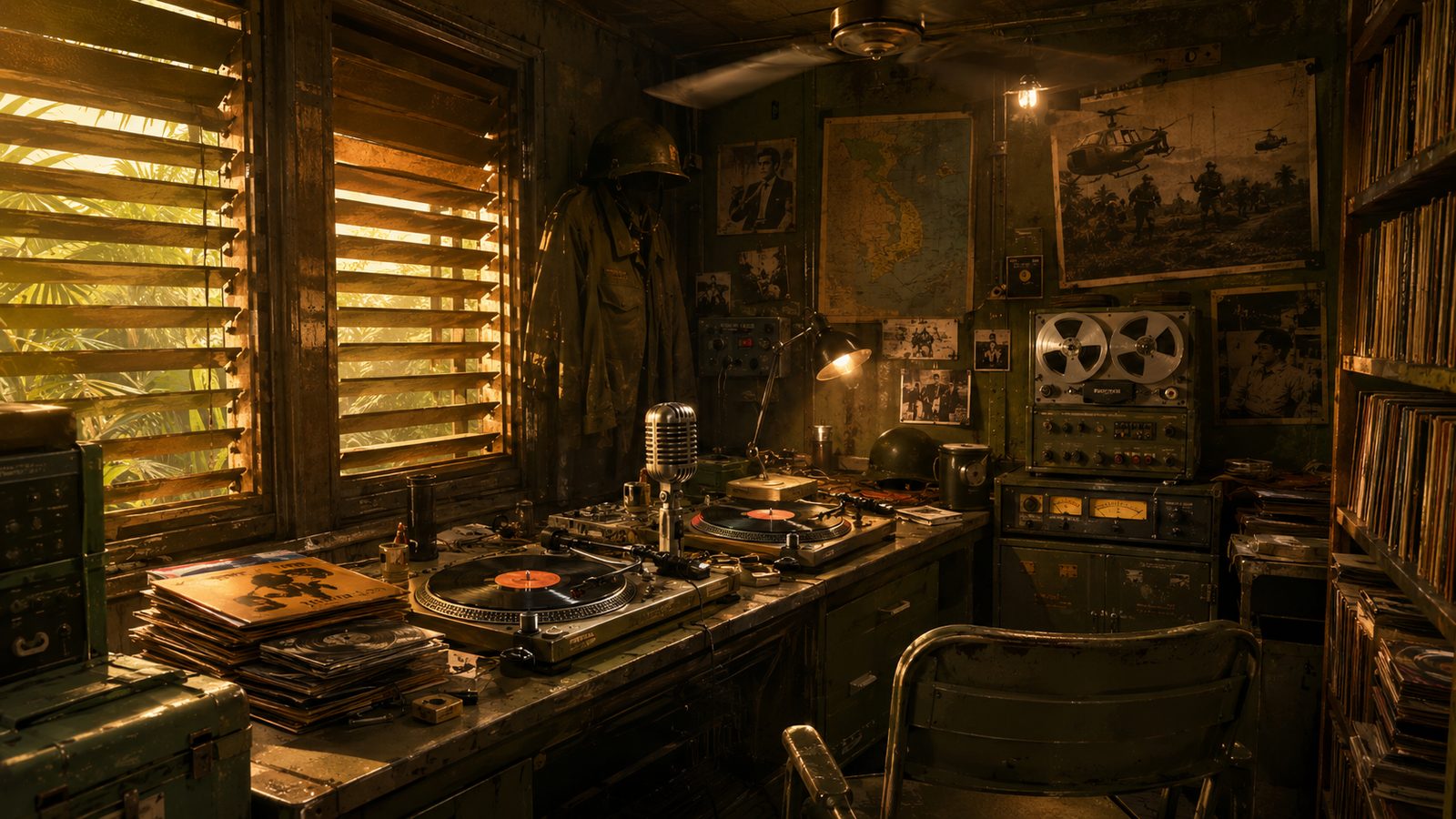
His studio is a cramped room full of military-issue broadcast equipment — turntables, reel-to-reel tape machines, a microphone, and stacks upon stacks of vinyl records. Every morning, Cronauer commandeers this room, drops a needle on a record, and opens with the line that gives the film its name: "Goooood morning, Vietnam!"
The turntable isn't just how he plays music — it's how he fights. While the military brass insists on approved content and censored news, Cronauer uses his turntable and his microphone to deliver truth, humor, and the uncensored sound of home. The turntable is a weapon of morale.
The gear
The AFRS studio in the film is equipped with broadcast-grade turntables — likely Gates, RCA, or QRK models, which were standard military broadcast equipment in the 1960s. These were built like tanks: heavy platters, precision motors, and cuing mechanisms designed for on-air use where a missed beat meant dead air.
The reel-to-reel tape machines visible in the studio are consistent with military-issue broadcast recorders — possibly Ampex or Magnecord units. These were used for recording broadcasts, playing pre-recorded segments, and (in Cronauer's case) probably archiving the shows that kept getting him in trouble.
The microphone prominently featured is a classic broadcast mic from the era — the visual suggests an RCA 77-DX or similar ribbon microphone, the standard voice mic for radio broadcasters from the 1940s through the 1970s.
"Goooood morning, Vietnam! Hey, this is not a test — this is rock and roll!"
— Adrian Cronauer (Robin Williams)
Why it matters
Good Morning, Vietnam earned Robin Williams a Best Actor nomination and remains one of the definitive portrayals of music as resistance. Cronauer doesn't carry a weapon — he carries a record collection. His power comes entirely from the turntable and the microphone.
The film captures something specific about the DJ-turntable relationship: the act of choosing a record IS the act of rebellion. Every song Cronauer plays is a deliberate choice to prioritize humanity over military protocol. The turntable gives him the power to control the soundtrack of an entire war zone.
Vintage broadcast turntables from the 1960s are available on eBay in the $200–$1,500 range, depending on brand and condition. Gates and QRK models are the most common. These are built for reliability, not hi-fi — they're the workhorses of broadcast history, designed to be cued, played, and abused for thousands of hours.
Affiliate disclosure: We may earn a commission from qualifying purchases made through links on this page, at no extra cost to you.
Audio-Technica AT-LP120X
~$250Direct-drive turntable with DJ-ready features. The modern equivalent of a broadcast turntable — precise cuing, reliable motor, built for daily use.
View on AmazonShure SM7B Microphone
~$400The gold standard broadcast microphone. Cronauer would have killed for this — warm, rich vocal tone that makes every "Good morning" sound legendary.
View on AmazonTASCAM 424 MKIII Cassette Recorder
~$500–$800Four-track cassette recorder for analog recording. The portable version of Cronauer's reel-to-reel studio — create your own broadcasts.
View on Amazon