Saving Private Ryan
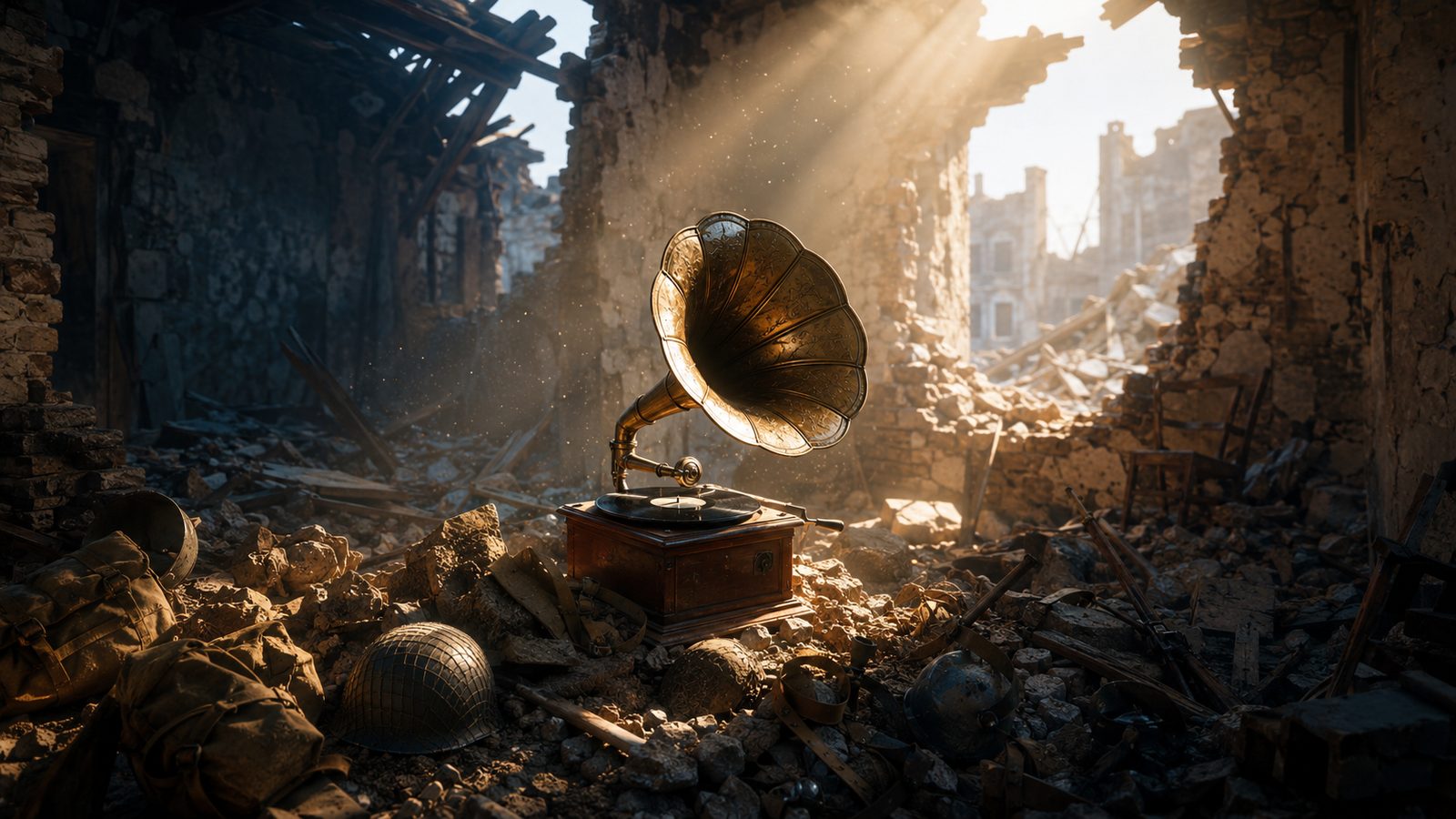
A wind-up gramophone playing Edith Piaf in the ruins of a French city — one of cinema's most powerful uses of music as emotional shelter.
The scene
Amid the devastation of a bombed-out French city, Captain Miller's squad takes shelter in a partially destroyed building. Outside, the war rages. Inside, someone finds a gramophone — a wind-up phonograph with a brass horn — and a record. The needle drops, and Edith Piaf's "Tu Es Partout" fills the broken room.
The soldiers sit in silence, listening. For a moment, the war doesn't exist. The music creates a fragile bubble of civilization in a place where civilization has been obliterated. One soldier translates the French lyrics — "You are everywhere" — and the irony lands quietly: beauty is everywhere, even here. Especially here.
It's a scene that Spielberg lets breathe. No score, no cuts to action. Just men, rubble, and a gramophone doing what gramophones have always done — making a room feel less empty.
The gear
The gramophone in the scene is a wind-up phonograph — the kind that needs no electricity, no amplifier, no speakers. The horn IS the speaker. A spring-loaded motor turns the platter, a steel needle reads the grooves, and the sound is amplified mechanically through the horn. It's audio playback at its most elemental.
This matters for the scene: there's no power in a bombed-out building. A gramophone is the only playback device that would actually work. The prop department chose well — this isn't just set dressing, it's the only historically plausible way these soldiers could hear music in that moment.
Wind-up gramophones were manufactured by dozens of companies from the 1900s through the 1950s. Major makers include Victor, Columbia, HMV (His Master's Voice), and Pathé. The one in the film appears to be a tabletop model with a brass morning-glory horn — a classic pre-electric design that would have been common in European homes of the 1940s.
"You are everywhere... your smile, your laugh... you are everywhere."
— Edith Piaf, "Tu Es Partout," translated in the film
Why it matters
This scene consistently appears on lists of the most emotionally powerful music moments in film history. It works because the gramophone isn't background — it's foreground. The act of finding it, winding it, choosing a record, dropping the needle — these physical rituals create the emotional space. You can't do this with a Bluetooth speaker.
The gramophone scene also captures something fundamental about analog audio: it's resilient. No electricity, no batteries, no signal — just a spring and a needle. In a world where everything has been destroyed, the simplest audio technology still works.
Vintage gramophones remain accessible to collectors. Working tabletop models from the 1920s–1940s sell on eBay for $200–$2,000 depending on condition, maker, and horn material. Brass-horn models command premiums. Complete, working units with original reproducers (the needle/diaphragm assembly) are the most desirable.
Affiliate disclosure: We may earn a commission from qualifying purchases made through links on this page, at no extra cost to you.
Victrola Nostalgic Record Player
~$50–$80A modern suitcase-style turntable with built-in speakers. Not a gramophone, but captures the "music anywhere" spirit of the scene at an entry-level price.
View on AmazonAudio-Technica AT-LP60X
~$150Fully automatic belt-drive turntable. The modern way to drop a needle and let music fill a room — reliable, affordable, no winding required.
View on AmazonPro-Ject Debut Carbon EVO
~$500Audiophile-grade turntable with carbon fiber tonearm. For when you want the ritual of analog playback with genuinely excellent sound quality.
View on Amazon