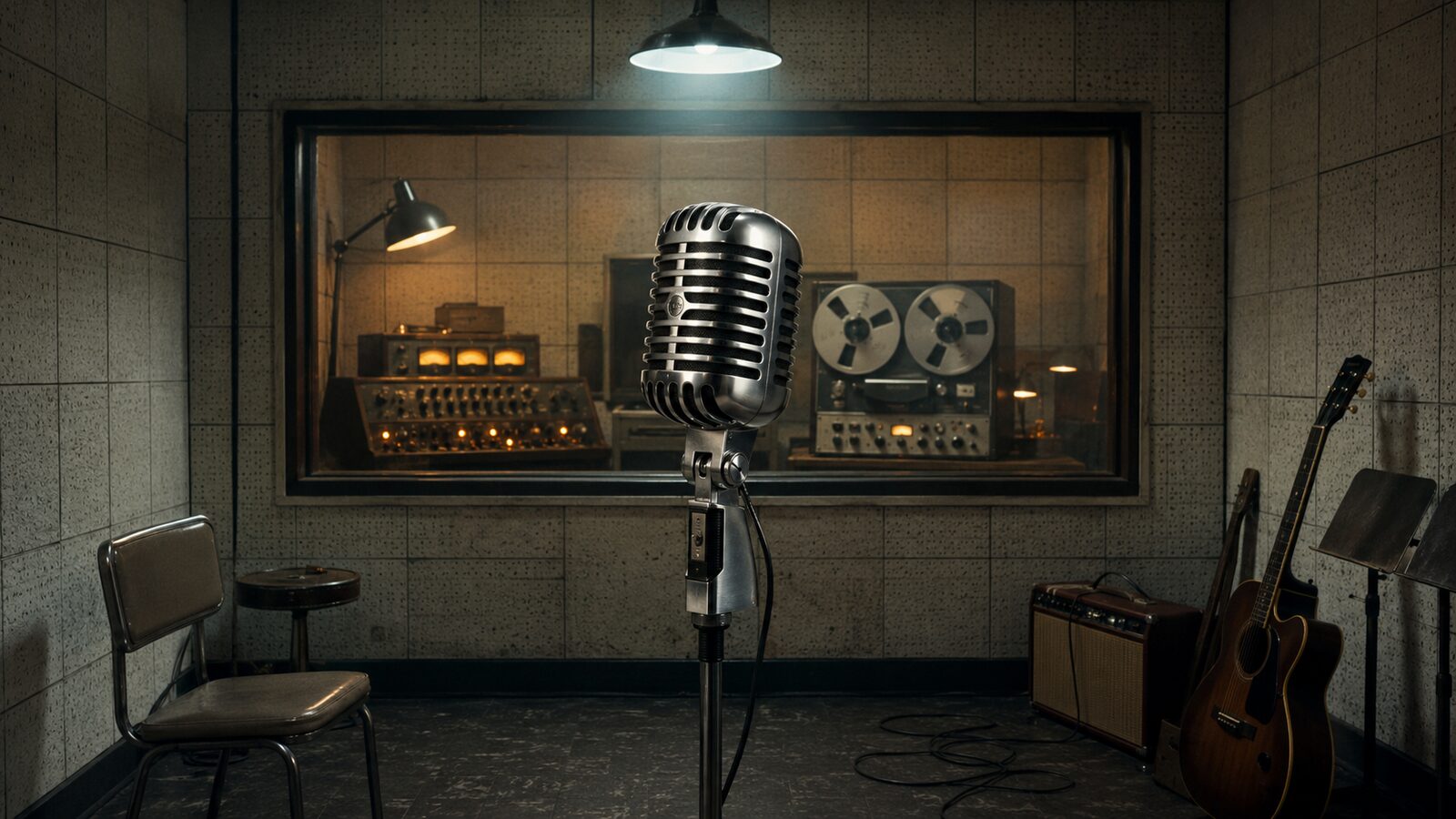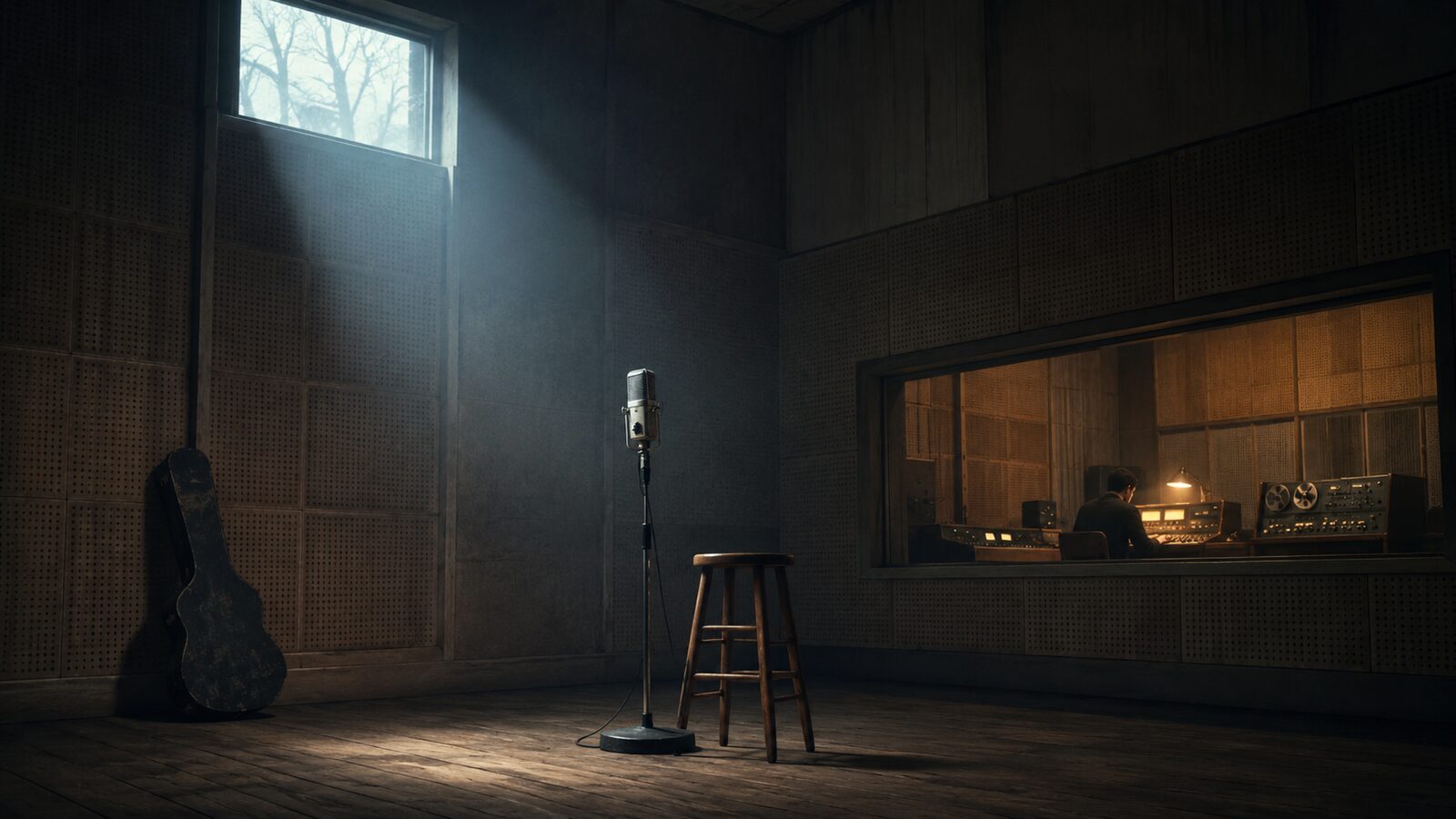
Columbia Recording Studios, New York City, 1961. The studio is nearly empty. A single Neumann U47 microphone stands on a tall boom in the center of a wood-floored room with high ceilings and acoustic panels. A wooden stool faces the mic. A guitar case leans against the far wall. Through the control room glass, an engineer sits at a small console next to an Ampex tape machine. Cool winter light falls from a high window, cutting through the dust.
Inside Llewyn Davis — the Coen Brothers' film about a struggling Greenwich Village folk singer — is one of the most visually austere music films ever made. The recording scenes at Columbia are period-precise: minimal miking, direct-to-tape, no overdubs. The gear philosophy of early 1960s folk recording was radical in its simplicity: one microphone, one take, one truth.
Oscar Isaac, who plays Llewyn Davis, performs every song live on camera — playing guitar and singing simultaneously into the same microphone, the same way folk singers recorded at Columbia in 1961. There is nowhere to hide in a setup this stripped down. Every breath, every fret noise, every hesitation is captured and preserved.
The Neumann U47 is the holy grail of studio microphones. Introduced in 1947, it was the first commercially successful condenser microphone and became the standard for vocal recording throughout the 1950s and 1960s. Frank Sinatra, the Beatles, and virtually every major artist of the era recorded through a U47. Its sound is warm, intimate, and detailed — it captures the human voice with a fidelity that still hasn't been surpassed.
In the film, the U47 is used alone — no second mic, no room mic, no separate guitar mic. This was standard practice for folk recording at Columbia in the early 1960s: the performer sat close to a single U47, which captured both the voice and the guitar in a natural balance. The result sounds like you're sitting three feet from the performer in a quiet room — which is exactly what's happening.
The Ampex tape machine in the control room recorded the performance in real time. There was no editing, no comping, no punch-ins. What the musician played was what went on the tape. If the performance wasn't good enough, they did another take. This constraint forced a level of preparation and presence that modern recording — with its infinite takes and surgical editing — doesn't demand.
If it was never new, and it never gets old, then it's a folk song.— Llewyn Davis, Inside Llewyn Davis
The Neumann U47 is the most valuable vintage microphone in the world. Working examples regularly sell for $8,000 to $15,000, and exceptional units — from specific serial number ranges or with documented provenance — have sold for over $20,000. The U47 stopped production in 1965, and the VF14 tube it requires hasn't been manufactured since the 1960s, making each surviving unit irreplaceable.
Neumann released the U47 FET in 1969 (a solid-state variant) and has more recently reissued the tube U47, but originals remain the standard against which all studio microphones are measured. The film captures the mystique of the U47 perfectly: it sits alone in an empty room, waiting, and the only thing that matters is what the performer brings to it.
The Coen Brothers' commitment to period accuracy extends to every detail of the recording scenes. The console, the tape machine, the mic placement, the room treatment — everything matches what Columbia's studios actually looked like in 1961. For anyone interested in the history of recording, these scenes are as close to a time machine as cinema gets.
Affiliate disclosure: We may earn a commission from qualifying purchases made through links on this page, at no extra cost to you.
The holy grail of studio microphones. Tube-powered, warm, impossibly detailed. The microphone that recorded Sinatra, the Beatles, and the golden age of popular music.
Professional reel-to-reel tape recorder. The machine that captured folk, jazz, and rock recordings at Columbia Studios through the 1960s. No undo, no editing — just tape and truth.
Faithful recreation of the Neumann U47 at a fraction of the vintage price. Tube-powered, large-diaphragm, with the warm, intimate vocal character of the original.
View on Amazon →Tube condenser microphone with a warm, detailed sound. An accessible entry point to the tube mic world without the five-figure vintage price.
View on Amazon →USB audio interface for direct-to-computer recording. The digital equivalent of sitting in front of an Ampex and pressing record.
View on Amazon →As an Amazon Associate we earn from qualifying purchases.