Little White Lies
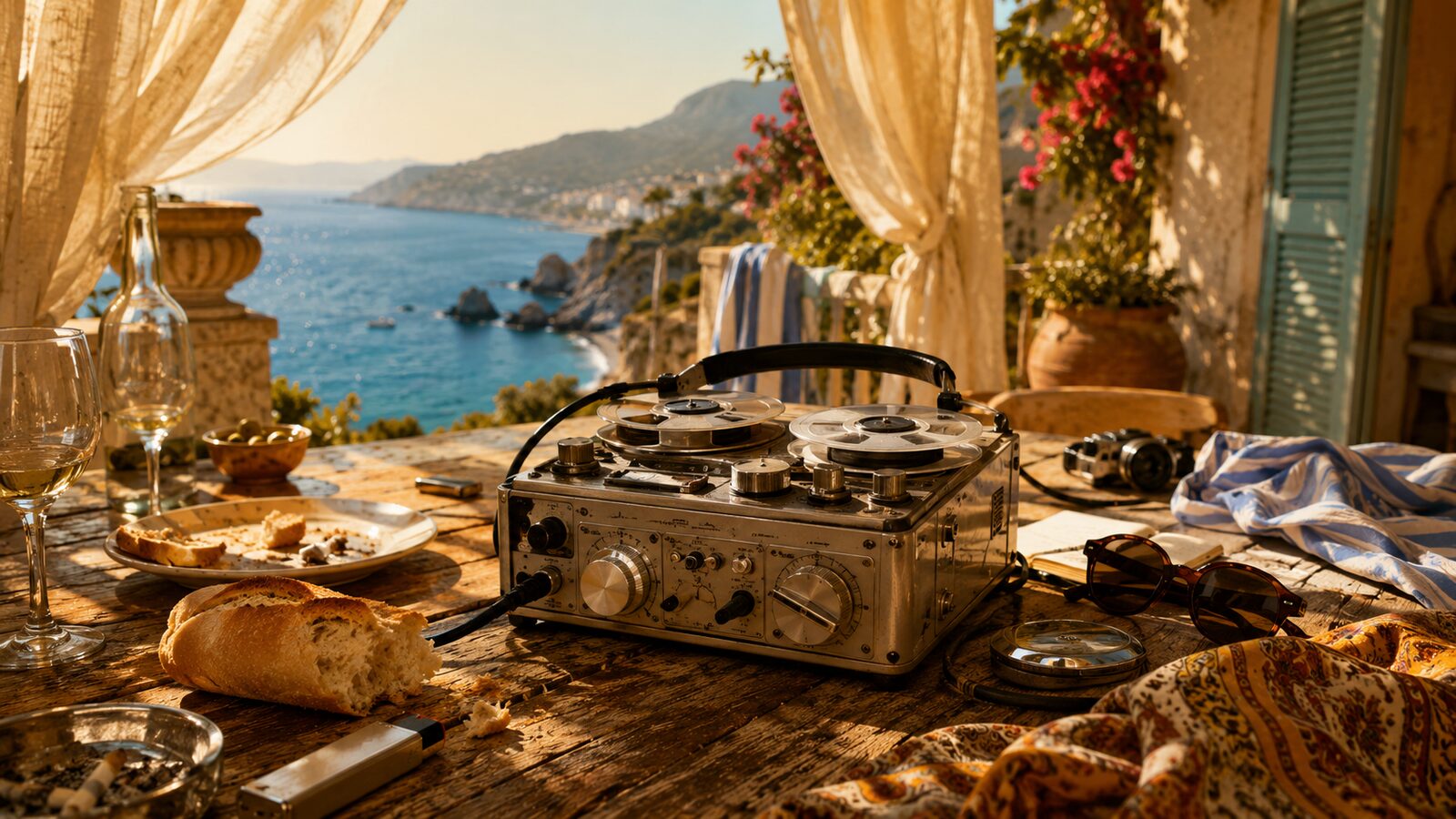
The Mediterranean coast of France, late summer. A group of Parisian friends gathers at a seaside villa for their annual holiday, carrying secrets that will unravel over the course of two sun-drenched weeks. Among the wine glasses, beach towels, and scattered personal effects, a Nagra IV-S reel-to-reel recorder makes an appearance — a serious machine in an unserious setting.
Guillaume Canet's ensemble drama is a French answer to The Big Chill, and the Nagra's presence speaks to the film's fascination with hidden truths. In a story about people who can't stop lying to each other, the recorder — a device built to capture reality without distortion — is an almost ironic prop.
The film's Riviera setting is all warmth and beauty: golden hour light, turquoise water, linen and terracotta. The Nagra sits in this paradise like a cold eye, precise and mechanical amid the messy humanity surrounding it.
The recorder shown in the film is a Nagra IV-S — the stereo upgrade to the legendary Nagra III. Produced from 1968 through the early 1990s, the IV-S was the recorder of choice for professional film production when stereo location sound was required.
The IV-S improved on the III with stereo recording capability, improved metering, and marginally lower noise. At roughly 7 kg loaded, it was still field-portable — a crucial requirement for location work. The characteristic brushed-aluminum faceplate and top-mounted carrying handle are immediately recognizable to anyone familiar with the Nagra family.
By 2010, the Nagra IV-S was long obsolete for professional use, having been supplanted by digital recorders in the early 2000s. Its appearance in a contemporary-set film suggests a character who values analog warmth and the ritual of reel-to-reel recording — or simply owns a beautiful machine.
We spend our whole lives pretending to be happy. Sometimes I forget what the real version looks like.
— Max (François Cluzet), Little White Lies
Little White Lies was a box-office hit in France, and its ensemble cast — Marion Cotillard, Jean Dujardin, François Cluzet — ensured international attention. The film's warmth and visual beauty made it a cultural touchstone for a certain kind of European summer cinema.
The Nagra IV-S occupies an interesting position in the recorder hierarchy. It's more accessible than the ultra-rare SN spy recorder, more capable than the mono III, and carries the full prestige of the Nagra name. Working IV-S units sell for $1,800–$5,000 on eBay, depending on condition and accessories.
For collectors, the Nagra IV-S represents the peak of analog portable recording technology. Nothing that came before it sounded better in a portable package, and the digital recorders that replaced it traded the IV-S's mechanical beauty for convenience. It is, arguably, the most beautiful audio device ever mass-produced.
Nagra IV-S Stereo Recorder
The pinnacle of portable analog recording — stereo capability in the legendary Nagra form factor. Arguably the most beautiful audio device ever mass-produced.
Zoom F3 Field Recorder
32-bit float stereo field recorder — compact, affordable, and the modern default for serious portable recording.
Sound Devices MixPre-6 II
Professional 6-input field recorder with USB audio interface. The Nagra IV-S's spiritual successor.
Tascam Portacapture X8
Multi-track handheld recorder with touchscreen interface — portable studio recording for the digital age.