The Lives of Others
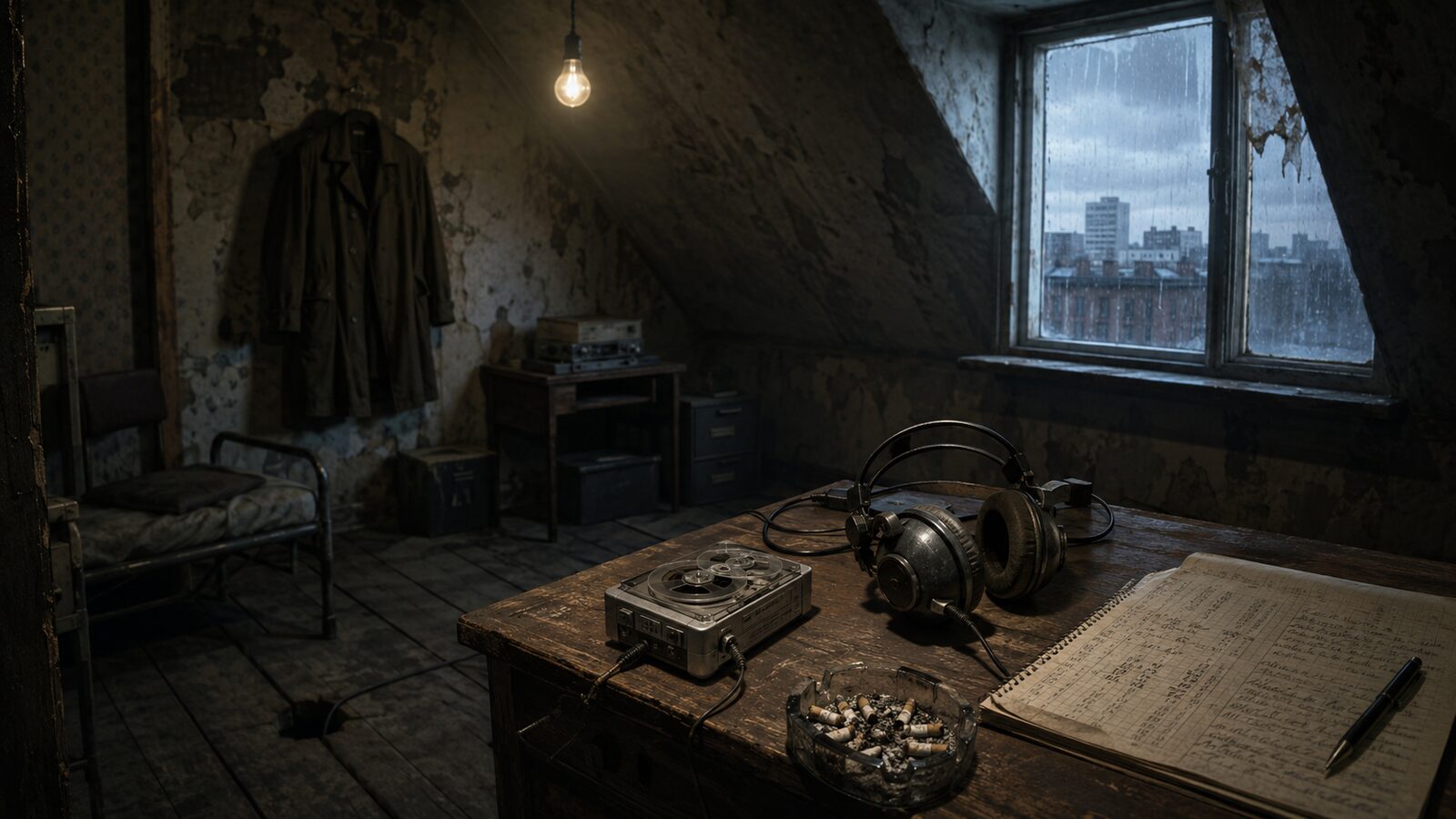
East Berlin, 1984. Stasi Captain Gerd Wiesler sits alone in an attic above a playwright's apartment, headphones clamped to his ears, a tiny reel-to-reel recorder spinning beside him. His assignment is to find evidence of subversion. What he finds instead is art, love, and the slow erosion of his own certainty.
Florian Henckel von Donnersmarck's Oscar-winning thriller is built entirely around the act of listening. Every scene in that attic — the careful threading of tape, the scratch of pen on logbook, the long silences between intercepted conversations — is a masterclass in tension through audio technology.
What makes the film extraordinary for gear obsessives is that every single piece of surveillance equipment on screen is real. The props master spent two years in a Stasi prison himself and insisted on absolute authenticity, borrowing actual Stasi-issue equipment from museums and private collectors.
The star of the attic is the Nagra SN — a cigarette-pack-sized reel-to-reel recorder originally developed by Stefan Kudelski's Kudelski SA in Switzerland. The SN (Série Noire) was designed specifically for intelligence work: it records on ultra-thin wire at imperceptibly slow speeds, fits in a coat pocket, and runs silently. The CIA, MI6, and — as the film documents — the East German Stasi all used it.
Alongside the SN, the film shows period-correct Stasi headphones, hardwired listening posts, and the mechanical letter-steaming machines that processed up to 600 intercepted letters per hour. The entire surveillance apparatus is presented with documentary precision.
The Nagra SN is one of the rarest consumer-adjacent audio devices ever made. Working units currently list at $3,350–$4,757 Buy-It-Now on eBay, with a mint 1974 SNN full-kit on Reverb asking $2,900. Non-working units start around $800. The film single-handedly elevated the SN from spy curiosity to collector grail.
To think that people once tried to run away from the Republic. Now they don't even try to leave their apartments.
— Captain Gerd Wiesler, The Lives of Others
The Lives of Others won the Academy Award for Best Foreign Language Film in 2007 and remains the definitive cinematic portrait of surveillance culture. It turned the Nagra SN from an obscure intelligence tool into a recognized cultural artifact.
For collectors, the film created a direct pipeline between Cold War history buffs and the vintage audio market. Nagra recorders of all types saw price increases in the years following the film's release, and the SN in particular became a fixture of spy memorabilia auctions.
The Nagra brand itself carries extraordinary cachet — founded in 1951 by Polish-Swiss engineer Stefan Kudelski, Nagra recorders became the standard for field recording in cinema, journalism, and intelligence. From The Conversation to Blow Out to this film, the Nagra is cinema's favorite recorder.
Nagra SN (Série Noire)
The cigarette-pack spy recorder used by the CIA, MI6, and Stasi. Records on ultra-thin wire at near-silent speeds. One of the rarest portable recorders ever made.
Nagra III Portable Recorder
The full-sized field recorder that defined professional location recording for five decades. Used across eight identified films from 1965 to 2010.
Zoom F3 Field Recorder
32-bit float field recorder with dual XLR inputs — the modern spiritual successor to the Nagra for documentary and film work.
Sound Devices MixPre-3 II
Professional-grade 3-channel field mixer/recorder with USB audio interface. The Nagra's true heir in the film industry.
Tascam DR-40X
Versatile handheld recorder with XLR inputs — an accessible entry point to serious field recording.