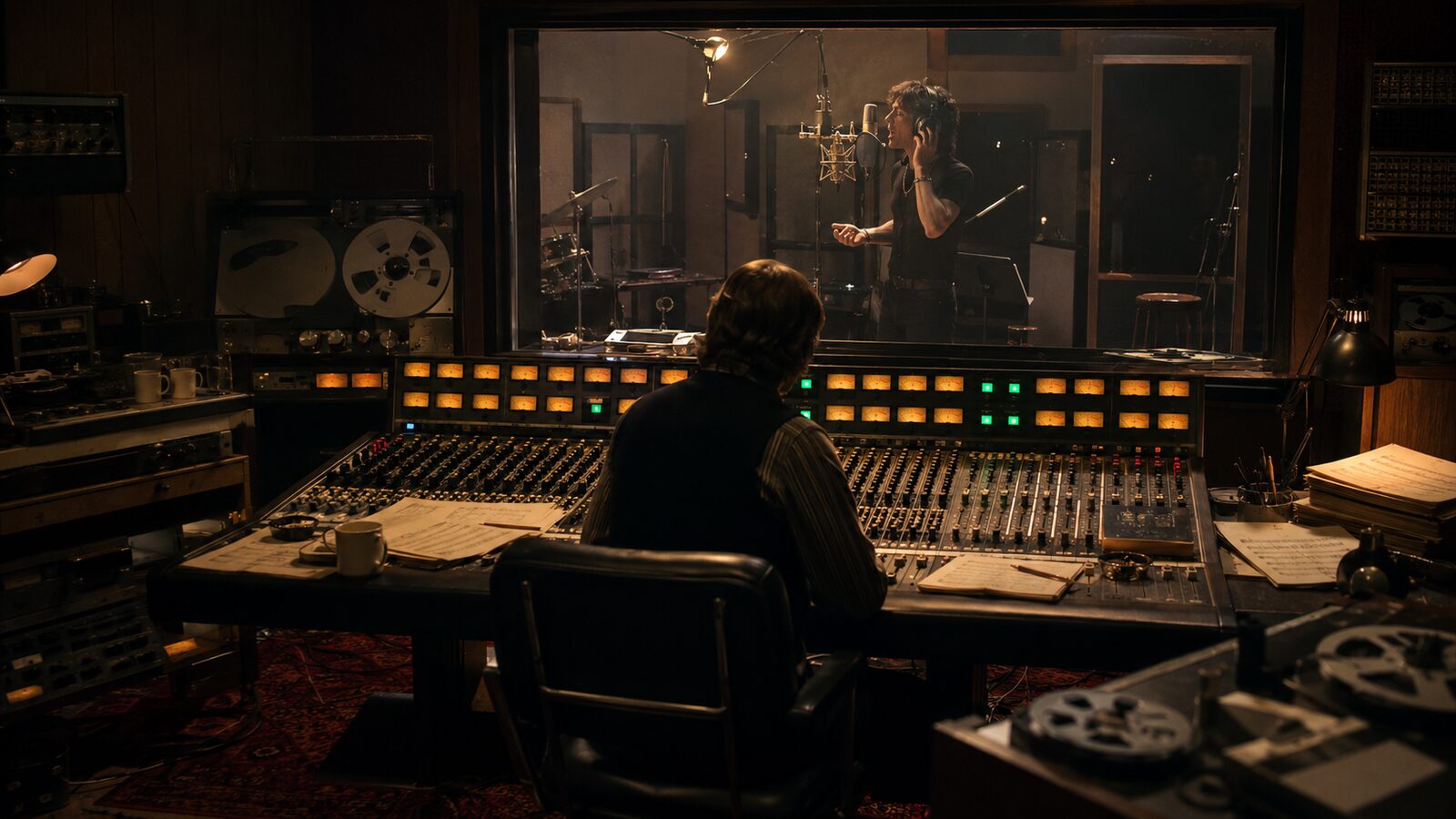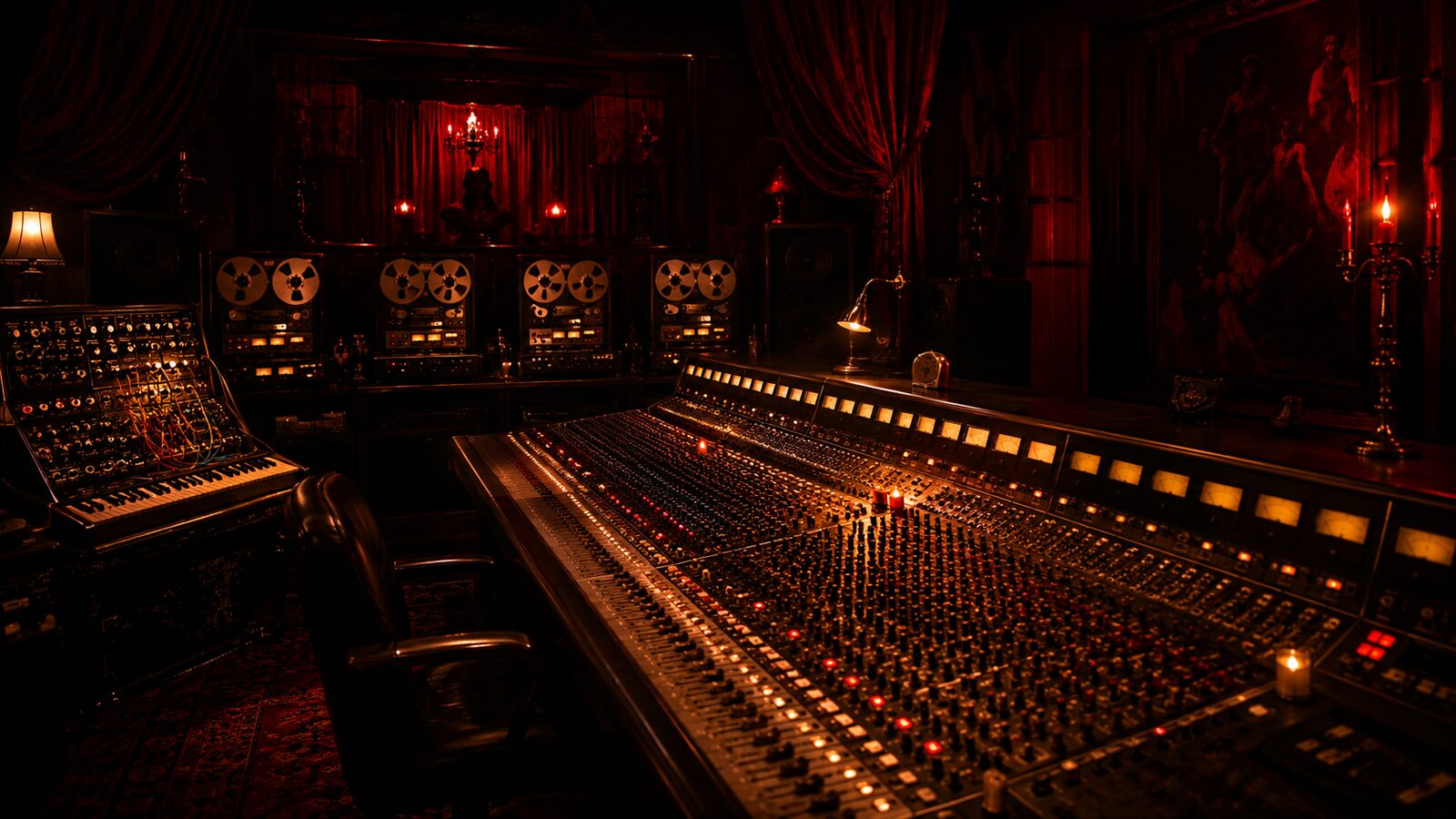
A cavernous recording studio, dark and theatrical. A massive mixing console stretches across the room, its faders and knobs disappearing into shadow. In the corner, a Moog synthesizer bristles with patch cables — dozens of colored wires connecting oscillators, filters, and amplifiers in configurations that look as much like mad science as music. Behind the console, reel-to-reel tape machines line the back wall, their reels spinning slowly, hypnotically.
Phantom of the Paradise — Brian De Palma's rock horror musical — is set almost entirely inside a recording studio and concert venue called The Paradise. A disfigured composer haunts the studio, sabotaging recordings and terrorizing the performers. The studio IS the setting, and every scene is dense with 1970s recording equipment: consoles, tape machines, synthesizers, monitors, and the mechanical infrastructure of analog music production.
Paul Williams scored the film and plays the villain, Swan — a record producer who literally sells his soul for hits. The Moog synthesizer, which was still exotic and slightly sinister in 1974, becomes a visual metaphor for technological corruption. The studio is beautiful, powerful, and dangerous — a cathedral of sound with a demon at the controls.
The Moog synthesizer visible in the film — with its tangle of patch cables and its wall of knobs — represents the instrument at its most visually dramatic. In 1974, modular Moog systems were the exclusive domain of experimental musicians and well-funded studios. They were enormous, temperamental, and capable of sounds that no other instrument could produce. The patch cable interface — where every sound required a physical connection between modules — made the Moog look like a telephone switchboard designed by a scientist, which is exactly the aesthetic De Palma wanted.
The mixing console that dominates the studio scenes is a custom prop based on real 1970s designs, likely inspired by Neve, API, or MCI consoles of the era. Its massive size — dozens of channel strips, hundreds of knobs — represents the industrial scale of professional recording in the 1970s, when a mixing console was the single most expensive piece of equipment in any studio.
The reel-to-reel tape machines serve both practical and symbolic purposes in the film. They're the recording medium, but their spinning reels also create a visual rhythm — a mechanical heartbeat that never stops, even when everything else goes wrong.
He sold his soul for rock and roll.— Tagline, Phantom of the Paradise
Phantom of the Paradise was a box office disappointment in 1974 but became one of the most influential cult films in music history. Daft Punk named their 2001 album Discovery partly in homage to the film, and its visual DNA — the marriage of recording technology and gothic theatrics — echoes through decades of music video and stage design.
Vintage Moog synthesizers have become some of the most valuable instruments on the collector market, with modular systems ranging from $3,000 to well over $15,000 depending on configuration and condition. The Minimoog Model D — the most recognizable Moog product — regularly sells for $5,000 to $10,000. Period studio monitors from the 1970s go for $200 to $1,000.
The film's lasting contribution is its vision of the recording studio as a space of both creation and destruction — a place where art is made, stolen, corrupted, and redeemed. For anyone who's ever felt that a recording studio has its own personality, its own agenda, Phantom of the Paradise is the definitive statement.
Affiliate disclosure: We may earn a commission from qualifying purchases made through links on this page, at no extra cost to you.
The original modular synthesizer — patch cables, oscillators, and filters creating sounds that had never existed before. Beautiful, temperamental, and slightly sinister.
Massive analog mixing console — the command center of a professional 1970s recording studio. Dozens of channel strips, hundreds of knobs, and the warm, harmonically rich sound of hand-wired circuitry.
Semi-modular analog synthesizer with patch points. The accessible entry to the Moog modular world without the five-figure vintage price.
View on Amazon →Affordable recreation of classic Moog modular modules. Build a full modular system for a fraction of the vintage cost.
View on Amazon →Modern hybrid synthesizer with polyphonic capability and extensive modulation. Weird, wonderful sounds at a fraction of vintage modular prices.
View on Amazon →As an Amazon Associate we earn from qualifying purchases.