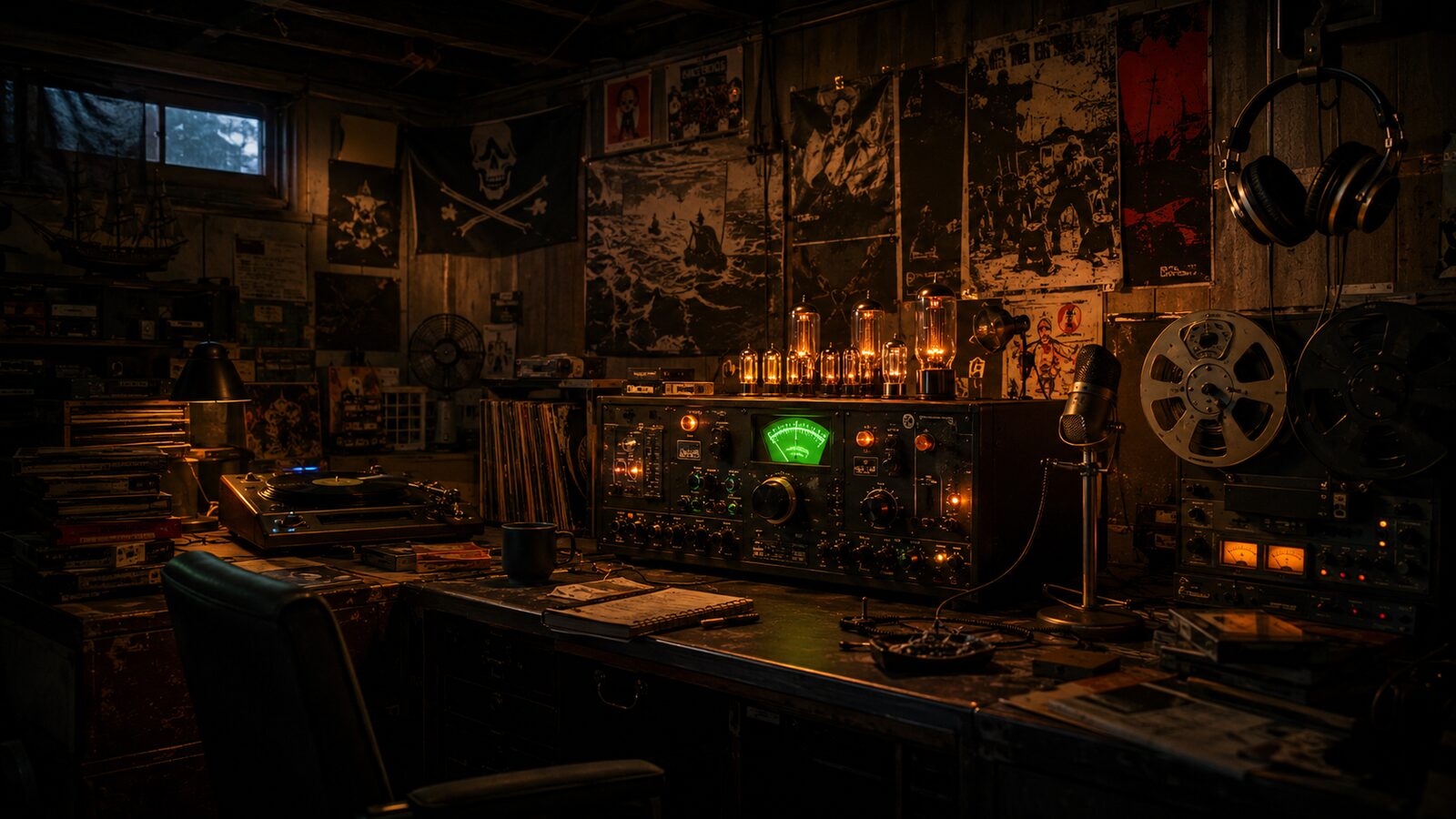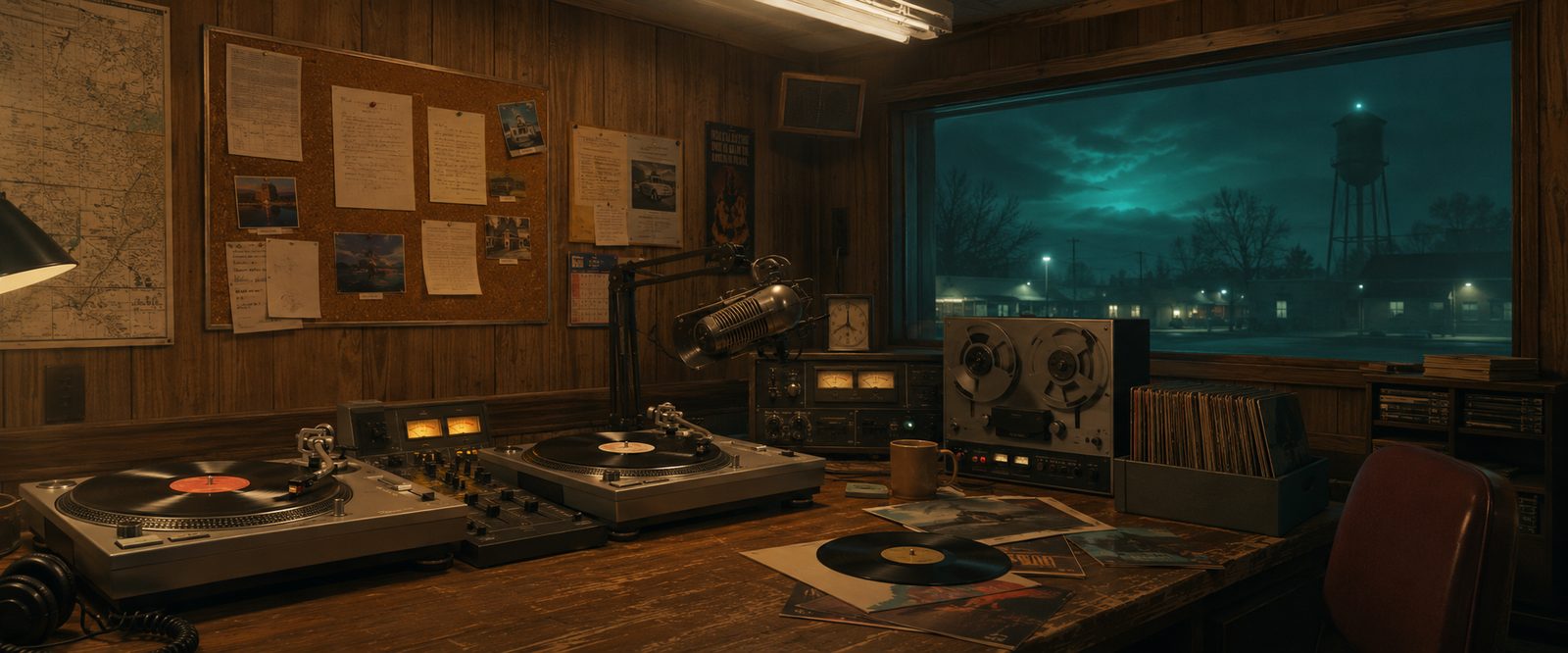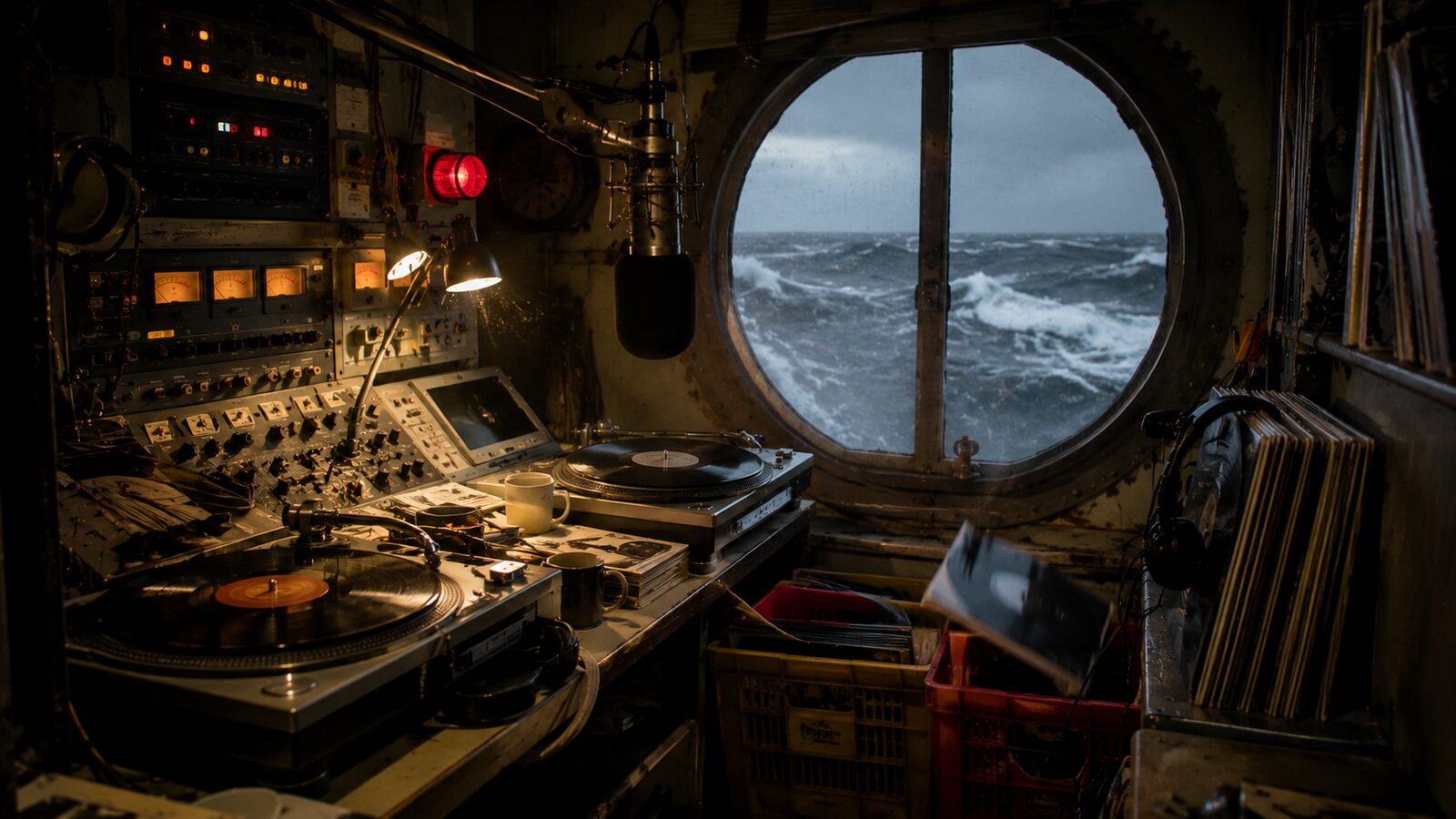
A cramped DJ booth on a ship anchored in the North Sea. Two broadcast turntables sit on a narrow desk that bolts to the wall — when the sea gets rough, the records skip and slide in their milk crates. A broadcast microphone on a boom arm hangs over the console. Through the porthole, grey waves churn under an overcast sky. The red ON AIR light glows. Somewhere on shore, twenty-five million people are listening.
Pirate Radio — released in the UK as The Boat That Rocked — tells the story of Radio Caroline and the other pirate radio stations that broadcast rock and roll from ships in the North Sea throughout the 1960s. The BBC had a near-monopoly on British broadcasting and devoted almost no airtime to pop and rock music. The pirate stations filled that void, operating in international waters beyond the reach of British law.
The film stars Philip Seymour Hoffman, Bill Nighy, and Nick Frost, and the ship-based DJ booths are packed with period-correct broadcast equipment. The gear kept a generation connected to the music their government didn't want them to hear — and the physical constraints of broadcasting from a moving vessel added a raw, unpredictable energy that no land-based studio could replicate.
The broadcast turntables visible in the film — likely Gates or QRK models — were purpose-built for radio stations. Unlike consumer turntables, broadcast units had instant-start motors, heavy platters for speed stability, and cue levers that could drop the needle precisely. On a ship in the North Sea, even these professional-grade turntables were constantly battling the motion of the waves.
The broadcast transmitter was the station's lifeline — a high-powered AM transmitter that pushed the signal to shore from a ship anchored in international waters. Radio Caroline's original transmitter was a 10-kilowatt unit that could reach most of southern England. The transmitter had to be marine-hardened against salt spray, humidity, and the constant vibration of a ship at sea.
The Shure SM7-style broadcast microphones on boom arms were the standard for radio DJ work. Their cardioid pattern rejected off-axis sound (important on a noisy ship), and their built-in windscreens handled the unsteady breathing of DJs who might be broadcasting through seasickness. The film captures the intimacy of speaking into a broadcast mic — the sense of talking to millions of people from a room the size of a closet.
These are the best days of our lives. It's a terrible thing to know, but I know it.— The Count, Pirate Radio
Radio Caroline first broadcast on Easter Sunday 1964, and within weeks it had an audience of millions. The pirate radio stations of the 1960s are directly responsible for the explosion of British rock music — without them, the Beatles, the Rolling Stones, the Kinks, and the Who would have had almost no radio exposure in their own country.
The British government eventually passed the Marine Broadcasting Offences Act of 1967, which made it illegal to supply, advertise on, or work for pirate radio stations. Most stations shut down. Radio 1 launched a few months later, essentially copying the pirate format. The pirates won the argument — they just lost the fight.
Vintage broadcast turntables like the Gates and QRK models depicted in the film sell for $300 to $1,500 on eBay. The Shure SM7B — the modern descendant of the broadcast mics used on the pirate ships — retails for about $400 and is the most popular podcast and broadcast microphone in the world. The irony: pirate radio's gear legacy lives on in every home podcaster who speaks into an SM7B from a bedroom closet.
Affiliate disclosure: We may earn a commission from qualifying purchases made through links on this page, at no extra cost to you.
Professional broadcast turntables built for radio stations. Instant-start motors, heavy platters, and precision cue levers. Designed for land-based studios, conscripted for duty on the North Sea.
Professional broadcast dynamic microphone with cardioid pattern and built-in windscreen. The voice of pirate radio — intimate, warm, and built to handle a ship that never stops moving.
The modern broadcast standard. Cardioid dynamic with built-in air suspension shock isolation. If pirate radio existed today, this is the mic they'd use.
View on Amazon →Professional DJ turntable with direct-drive motor and high torque. The modern descendant of broadcast turntables, built for precision and durability.
View on Amazon →USB audio interface for modern broadcasting. Two inputs, low latency, and studio-quality preamps in a package small enough for a ship's cabin.
View on Amazon →As an Amazon Associate we earn from qualifying purchases.