Twin Peaks
A Wurlitzer jukebox in the Double R Diner, a turntable in the Palmer house — David Lynch uses audio playback as the thin membrane between warmth and dread.
The scene
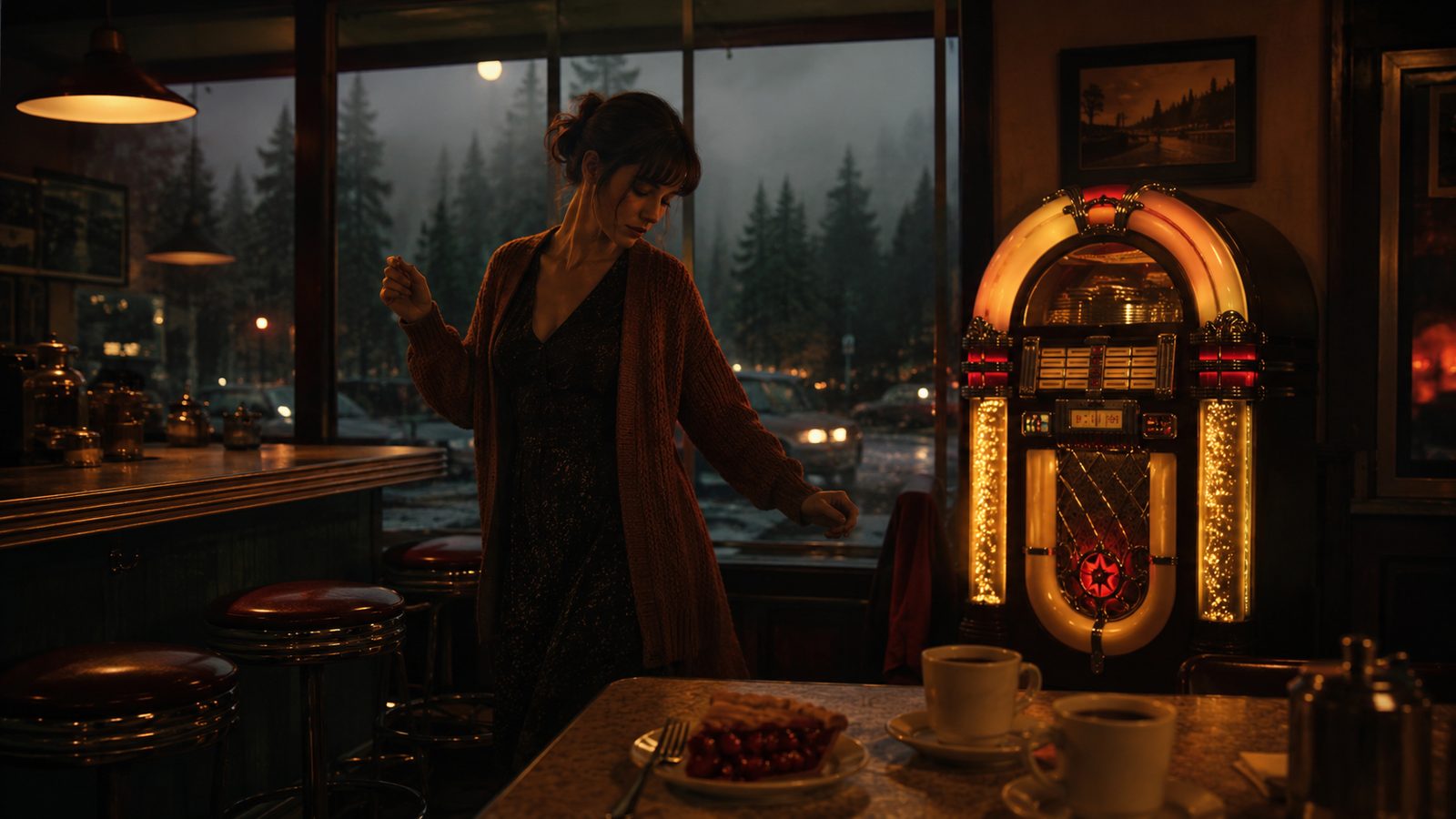
David Lynch understands sound better than almost any filmmaker alive. In Twin Peaks, audio playback devices aren't props — they're narrative instruments. The Wurlitzer jukebox in the Double R Diner glows amber and red in the corner, its bubble tubes pulsing. Audrey Horne dances to it, alone, swaying to a dreamy instrumental. It's one of the most iconic scenes in television history.
But Lynch also uses turntables for darker purposes. In Jacques Renault's cabin, a record player loops endlessly — "where there's always music in the air." In the Palmer house, a turntable's runout groove — the rhythmic click-click-click of a needle past the last track — soundtracks one of the series' most disturbing scenes. The music has ended, but the machine keeps spinning.
Lynch's genius is in understanding that audio playback devices have two states: playing and not-playing. Both are meaningful. A jukebox playing is warmth. A turntable in runout is dread.
The gear
The Double R Diner jukebox is a classic Wurlitzer — the most recognizable jukebox design in the world, with its arched top, chrome trim, and illuminated bubble tubes. Wurlitzer jukeboxes from the 1940s–1960s are iconic pieces of Americana, and the Double R's model is consistent with a late-model Wurlitzer from that era.
The turntables appearing throughout the series — in the Palmer house, in Jacques Renault's cabin, in various characters' homes — are typically modest consumer models. Lynch doesn't use expensive audiophile equipment; he uses the kind of turntables that ordinary people would own. The horror comes from context, not from the gear.
The runout groove — the locked groove at the end of a vinyl record that causes the needle to repeat endlessly — is Lynch's most brilliant audio device. It's a sound that every vinyl listener recognizes: the moment the music ends but the machine doesn't stop. In Lynch's hands, it becomes the sound of something that should have ended but won't.
"The owls are not what they seem."
— The Giant (Carel Struycken)
Why it matters
Twin Peaks transformed television and remains one of the most influential shows ever made. Lynch's use of audio — both the music and the machines that play it — is studied in film schools alongside his visual techniques. The jukebox scene with Audrey Horne has been referenced, parodied, and homaged countless times.
Lynch's approach to audio playback is unique in television: he treats the devices themselves as characters. The jukebox has a personality — warm, inviting, safe. The runout groove has a personality — persistent, mechanical, wrong. No other filmmaker has extracted so much narrative meaning from the physical mechanics of vinyl playback.
Vintage Wurlitzer jukeboxes sell on eBay for $1,000–$10,000+ depending on era, model, and condition. Fully restored units from the 1940s–1950s command the highest prices. They're as much sculpture as audio equipment — which is exactly how Lynch uses them.
Crosley Rocket Jukebox
~$500Modern full-size jukebox with Bluetooth and CD. The Double R Diner look without the five-figure restoration budget.
View on AmazonPro-Ject Debut Carbon EVO
~$500For recreating the other side of Twin Peaks — the turntable scenes. Precise, beautiful, and capable of producing a very unsettling runout groove.
View on AmazonAngelo Badalamenti "Twin Peaks" Soundtrack Vinyl
~$30The soundtrack that defined atmospheric television. "Audrey's Dance" sounds best on the format Lynch intended — vinyl.
View on Amazon