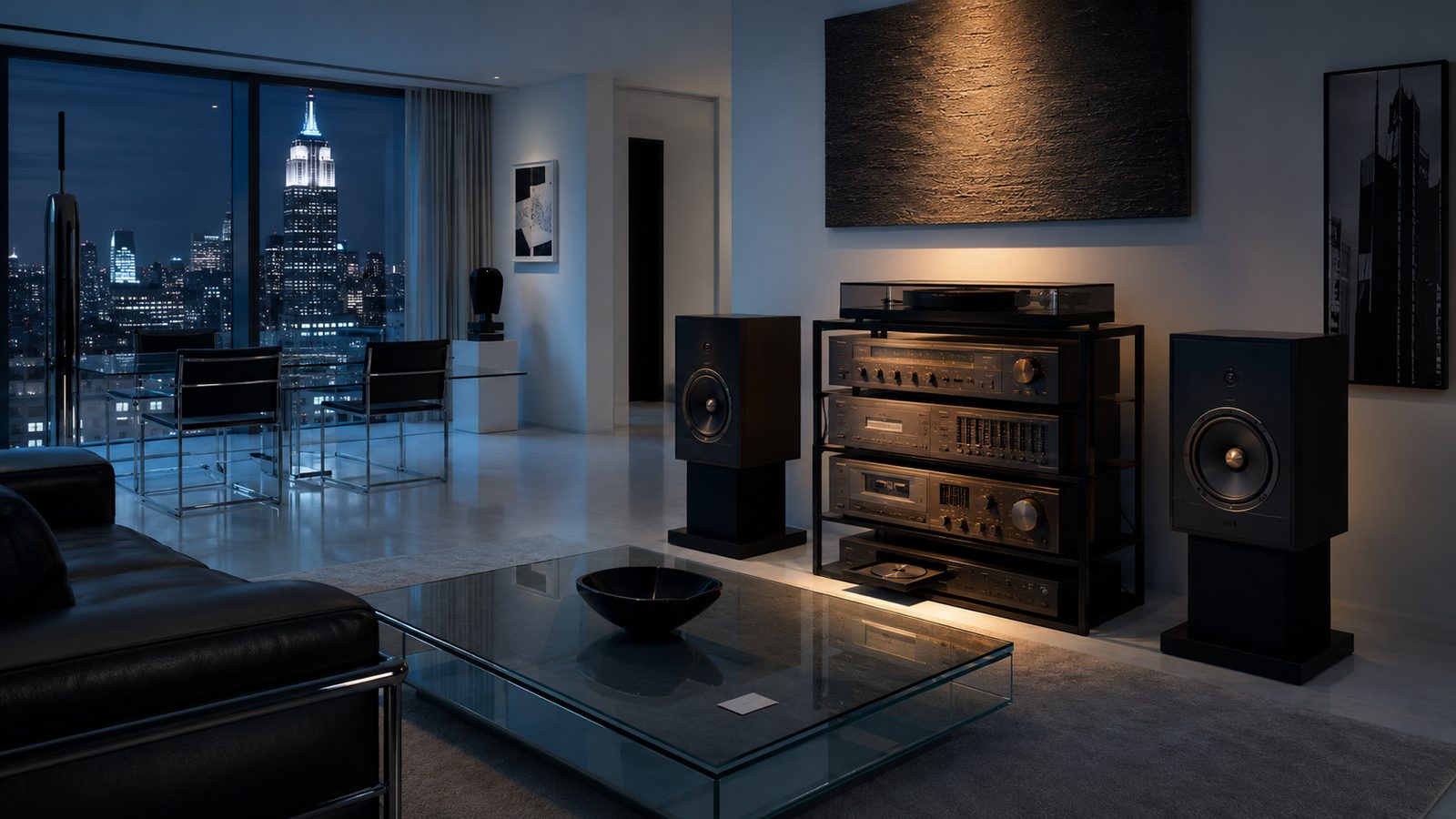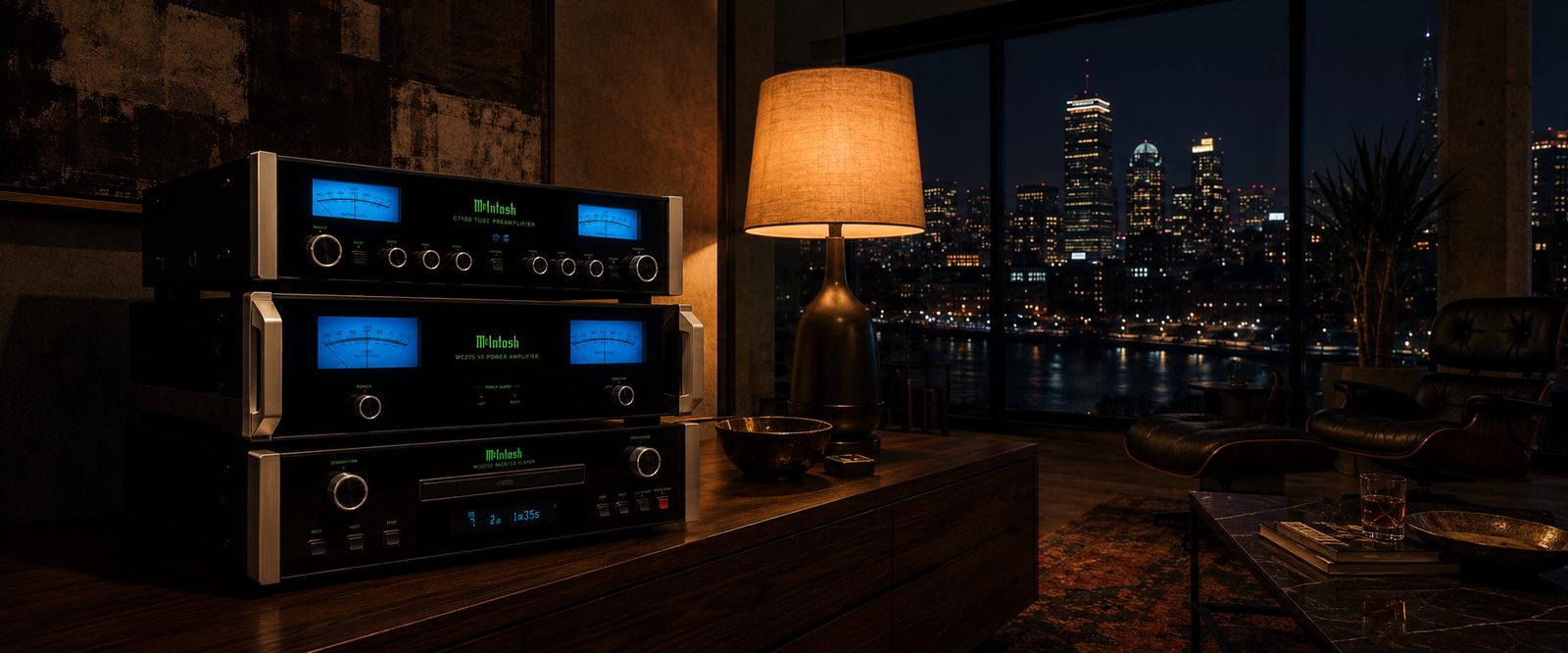
Two of the most memorable stereo systems in cinema belong to two of the most reprehensible characters ever written. Patrick Bateman — Wall Street investment banker, serial killer, obsessive about business cards and Huey Lewis — keeps a pristine Harman Kardon component stack in his glacial Manhattan apartment. Frank Costello — Boston's Irish mob boss, Jack Nicholson at his most terrifying — has a full McIntosh system glowing in his penthouse while he conducts business that would make Bateman flinch.
Both men use their stereos as extensions of their personalities. Both systems are real, identifiable, and available on the collector market today. The question is: which one sounds better?
The Bateman rig: Harman Kardon 700 Series
Bateman's system, visible during the infamous "Hip to Be Square" scene, is a Harman Kardon component stack from the late 1980s. It's been identified by the audio community as an HK 725 preamplifier, HK 770 power amplifier, HK EQ7 graphic equalizer, and HK 440xm cassette deck, paired with a Pioneer PD-4300 CD player and what appear to be KEF speakers.
It's a solid mid-range system by 1980s standards — respectable, competent, exactly the kind of thing a young Wall Street guy would buy to signal taste without actually having it. The HK 770 puts out around 65 watts per channel. The EQ7 is there for show as much as anything — Bateman strikes you as someone who'd boost the treble and the bass and scoop the mids, the sonic equivalent of his slicked-back hair.
The whole stack can be had on eBay today for $500 to $1,500 depending on condition. Individual pieces run $100–$400 each. It's vintage, it's functional, and it's a perfectly decent way to listen to Genesis.
The Costello rig: McIntosh everything
Costello's system is in another universe entirely. The Departed's production design team stocked his penthouse with a full McIntosh system: MX119 A/V processor, MC207 seven-channel power amplifier, MVP861 universal disc player, MA6500 integrated amplifier, MCD1000 SACD/CD player, and XLS 320 speakers. Six McIntosh components, all with those iconic illuminated blue VU meters and green logos.
This is not a system assembled by someone trying to look wealthy. This is a system assembled by someone who is wealthy and actually cares about sound. The MC207 alone delivers 200 watts per channel across seven channels. The MCD1000 was McIntosh's flagship disc player. At retail, this system would have cost somewhere north of $15,000. On today's vintage market, individual McIntosh components from this era sell for $1,000–$5,000+ each.
The difference between these two setups is the difference between the characters themselves. Bateman buys what he thinks he should own. Costello owns what he actually wants.
The verdict
Costello wins, and it's not close. The McIntosh system outclasses the Harman Kardon stack in every measurable way — power, build quality, component pedigree, resale value. But the real victory is philosophical. Bateman's system is performative; it exists so he can talk about it during murders. Costello's system exists because the man likes to sit in his penthouse and listen to the Dropkick Murphys at reference volume while running the Boston underworld. One is a prop. The other is a lifestyle.
Bateman would be furious about this ranking, and that's exactly why it's correct.