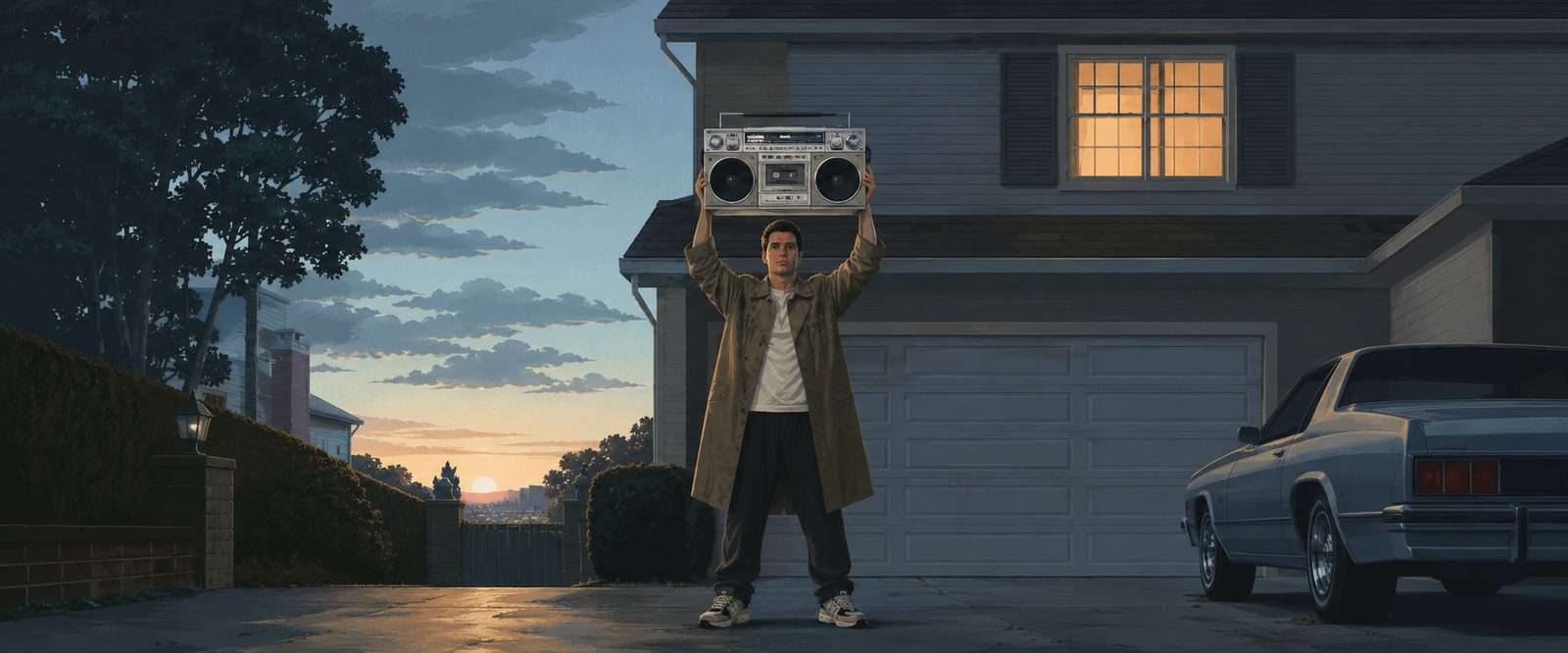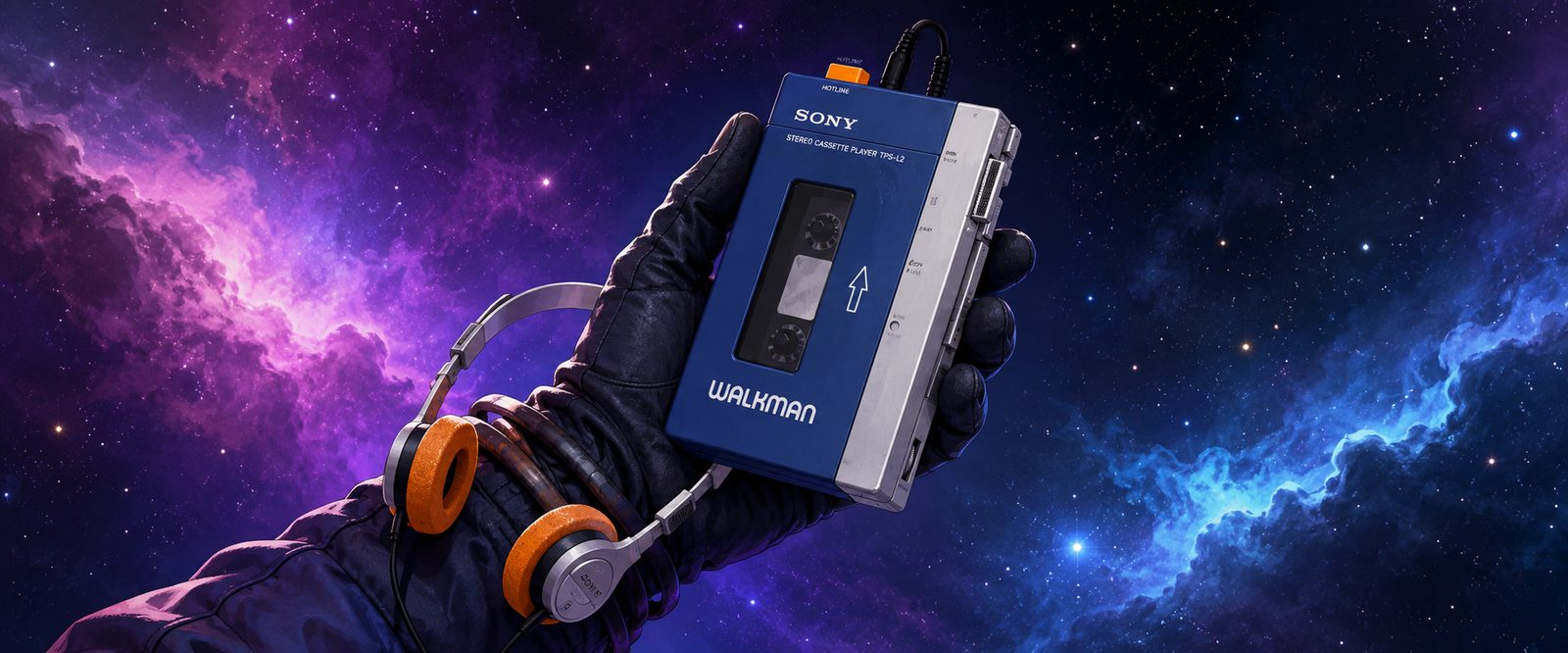
There are exactly two moments in cinema where a character holding audio gear became the entire point of the scene. The first: Lloyd Dobler standing in a suburban driveway at dawn, holding a Sharp GF-7600 boombox over his head, blasting "In Your Eyes" at Diane Court's window. The second: Peter Quill dancing alone through an alien temple, Sony TPS-L2 Walkman clipped to his belt, "Come and Get Your Love" in his headphones, completely lost in the music.
These two moments represent opposite philosophies of what music is for. Dobler's is a declaration — music as a public act, a grand gesture, sound weaponized for love. Star-Lord's is an escape — music as a private sanctuary, a connection to a dead mother and a lost planet, the last thread to his humanity in a galaxy that doesn't care about Redbone.
The Dobler rig: Sharp GF-7600
The boombox from Say Anything is a Sharp GF-7600, a mid-range portable stereo from the early 1980s. It's not the biggest boombox (that would be the JVC RC-M90 or the Sharp GF-777), and it's not the most expensive. It's a practical, two-speaker, single-cassette unit — the kind of boombox a teenager in 1989 would actually own. That's part of what makes the scene work. Lloyd isn't flexing with a $500 ghetto blaster. He's using what he has.
On the collector market, the GF-7600 runs $200–$600 depending on condition. It's sought after almost entirely because of this film. Interestingly, the boombox on the movie poster is a different model — a Toshiba RT-SX1 — because Hollywood has never cared about continuity when it comes to audio equipment.
The Star-Lord rig: Sony TPS-L2 Walkman
Star-Lord's Walkman is the Sony TPS-L2 — the original Walkman, released in 1979. It was the first commercially successful portable stereo cassette player, and it changed the way humans related to music forever. Before the Walkman, music was either communal (speakers, boomboxes, car stereos) or stationary (home systems). The TPS-L2 made music personal and mobile for the first time.
In Guardians of the Galaxy, the Walkman isn't just a music player — it's Peter Quill's last physical connection to Earth and to his mother, who gave it to him before she died. The "Awesome Mix Vol. 1" cassette inside it drives the entire film's soundtrack. When Quill risks his life to retrieve the Walkman from an evidence locker, you understand completely.
Original TPS-L2 Walkmans in working condition sell for $200–$800+ on eBay, with mint examples occasionally breaking four figures. The film spiked demand significantly — it's now the most famous Walkman ever made.
Dobler plays music AT someone. Star-Lord plays music FOR himself. Both are acts of vulnerability — one just does it louder.
The verdict
It depends on what you believe music is for. If music is communication — a way to tell someone what you can't say in words — then Lloyd Dobler wins. He turns a boombox into a love letter. The Sharp GF-7600 in that driveway scene is the most romantic piece of audio equipment ever filmed.
If music is survival — a way to stay yourself when everything around you is alien and hostile — then Star-Lord wins. The TPS-L2 Walkman is his identity, his comfort, his connection to everything he's lost. It's the most emotionally important piece of audio equipment ever filmed.
We're giving it to Star-Lord by a hair, because the Walkman changed the world and the movie used it to tell a story about grief and identity that no boombox scene has ever matched. But ask us again tomorrow and we might flip.