Home / As Seen In / Albums
The Gear Behind Aphex Twin’s Cheetah EP
Richard D. James named an entire EP after a failed 1989 British synthesizer that almost nobody had heard of. Then he made it sound like the future.
📺 Album / Production 📅 2016 ⏱ 6 min read
The Scene
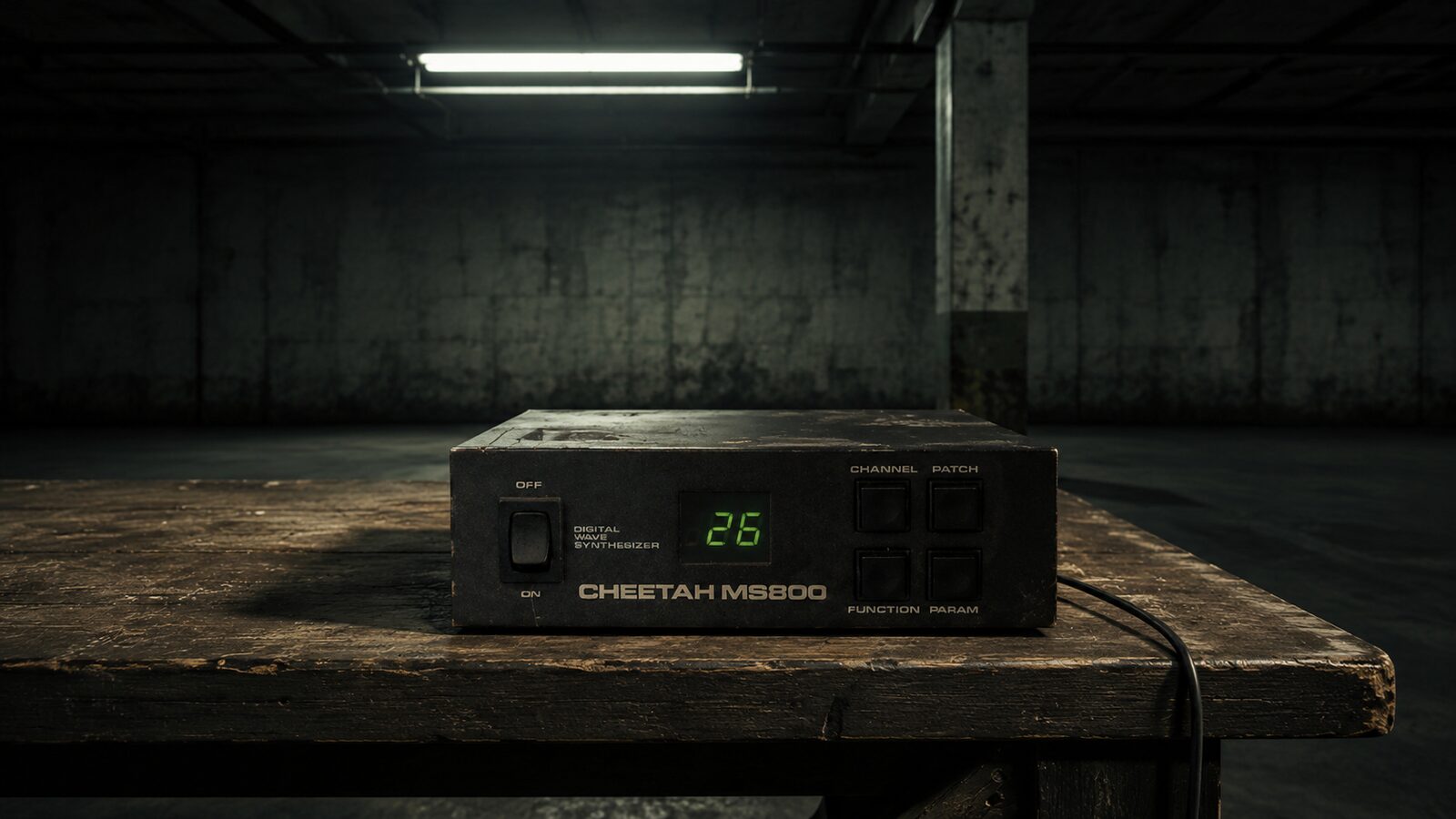
In 2016, after a 13-year hiatus broken only by Syro in 2014, Aphex Twin released the Cheetah EP — five tracks named after an obscure digital wave synthesizer made by a small British company called Cheetah Marketing Ltd. The Cheetah MS800 was released in 1989, sold poorly, and was largely forgotten by the time James got his hands on one.
The EP was accompanied by a promotional campaign that played the synth’s obscurity for maximum absurdist effect — fake advertisements for the MS800 appeared on billboards and in print, styled like genuine 1989 tech marketing. The joke was that James had taken the most forgotten synthesizer in history and made it the star of a major release.
But the music was no joke. The five tracks are dense, intricate, and rhythmically relentless — classic Aphex Twin complexity filtered through the MS800’s distinctive digital wave-sequencing engine. The synth’s original selling point was its ability to morph between waveforms in real time, creating evolving, shifting timbres that sat somewhere between FM synthesis and wavetable scanning.
The Gear
The Cheetah MS800 was a wave-sequencing synthesizer released in 1989 by Cheetah Marketing Ltd., a small Welsh electronics company better known for budget Amiga peripherals and MIDI interfaces. The MS800 was their attempt at a serious professional synthesizer, and it was a commercial disaster.
The concept was ambitious — the MS800 could store and morph between digital waveforms in sequences, creating timbres that evolved over time. In theory, this put it in the same category as the Korg Wavestation and PPG Wave. In practice, the interface was nearly impenetrable, the tiny LCD screen offered minimal feedback, and the build quality felt cheap compared to Japanese competition. Cheetah folded shortly after.
James’s genius was recognizing that the MS800’s supposed weaknesses — its unpredictable wave morphing, its brittle digital character, its resistance to conventional programming — were actually creative strengths when pushed into experimental territory. The EP proved that forgotten, unloved gear could produce sounds that no modern plugin could replicate.
After the EP’s release, MS800 prices spiked from near-worthless to $400–$800 on eBay and Reverb. Units remain rare — Cheetah’s production numbers were tiny — and the market has stayed elevated since.
“The Cheetah MS800 is one of seven pieces of gear that helped define Aphex Twin’s pioneering sound — an obscure 1989 British digital synth that spiked in price after the EP dropped.”
— FACT Magazine, “7 Pieces of Gear That Helped Define Aphex Twin’s Pioneering Sound” (2017)
Why It Matters
The Cheetah EP is the purest example of Aphex Twin’s philosophy: that the most interesting sounds come from gear nobody else wants. By naming an entire release after the synth, James single-handedly rescued the MS800 from total obscurity and created a collector’s market where none existed.
For gear hunters, the MS800 represents the ultimate “Aphex Twin effect” — the phenomenon where any piece of equipment associated with James immediately appreciates in value. The same thing happened with the Rephlex-era gear on Syro’s printed gear list, and with the Oberheim Matrix-1000 after SAW II.
The EP also served as an accidental eulogy for an entire era of British synth manufacturing. Companies like Cheetah, Oxford Synthesiser Company, and EDP tried to compete with Roland and Yamaha in the 1980s and mostly failed. James proved their instruments deserved a second life.
The Gear Cards
The Namesake
Cheetah MS800
The obscure 1989 Welsh wave-sequencing synthesizer that Richard D. James named an entire EP after. Rare, quirky, and impossible to replicate with plugins. Prices spiked after the 2016 release and have stayed elevated.
| Type | Digital wave-sequencing synthesizer |
| Year | 1989 |
| Voices | 8-voice polyphonic |
| Waveforms | Wave morphing/sequencing |
| Maker | Cheetah Marketing Ltd. (Wales) |
| Status | Extremely rare |
The Companion
Akai S950 Sampler
The 12-bit sampler that appeared on the Syro gear list alongside the MS800. James used Akai samplers extensively throughout his career. The S950’s gritty digital character pairs perfectly with the MS800’s wave-sequencing.
| Type | 12-bit digital sampler |
| Year | 1988 |
| Sample Rate | Up to 48kHz |
| Memory | 750KB (expandable to 2.25MB) |
| Outputs | 8 individual + stereo |
| Status | Cult classic |
Modern Alternatives
Korg Wavestate
~$500
Modern wave-sequencing synthesizer inspired by the Korg Wavestation. The accessible way into the wave-morphing sounds the MS800 pioneered.
View on Amazon →Modal Electronics Argon8
~$600
Modern wavetable synthesizer with deep morphing capabilities. British-made, like the Cheetah — but with an interface you can actually use.
View on Amazon →Aphex Twin — Cheetah EP (Vinyl)
~$25
The 2016 Warp Records release on 12″ vinyl. Five tracks of dense, intricate Aphex Twin built entirely around the MS800.
View on Amazon →Affiliate Disclosure: Stereos For Sale earns commissions from purchases made through our Amazon and eBay links. This helps keep the site running. Every product we recommend is something we’d genuinely want to own. Learn more.