Aphex Twin — Syro
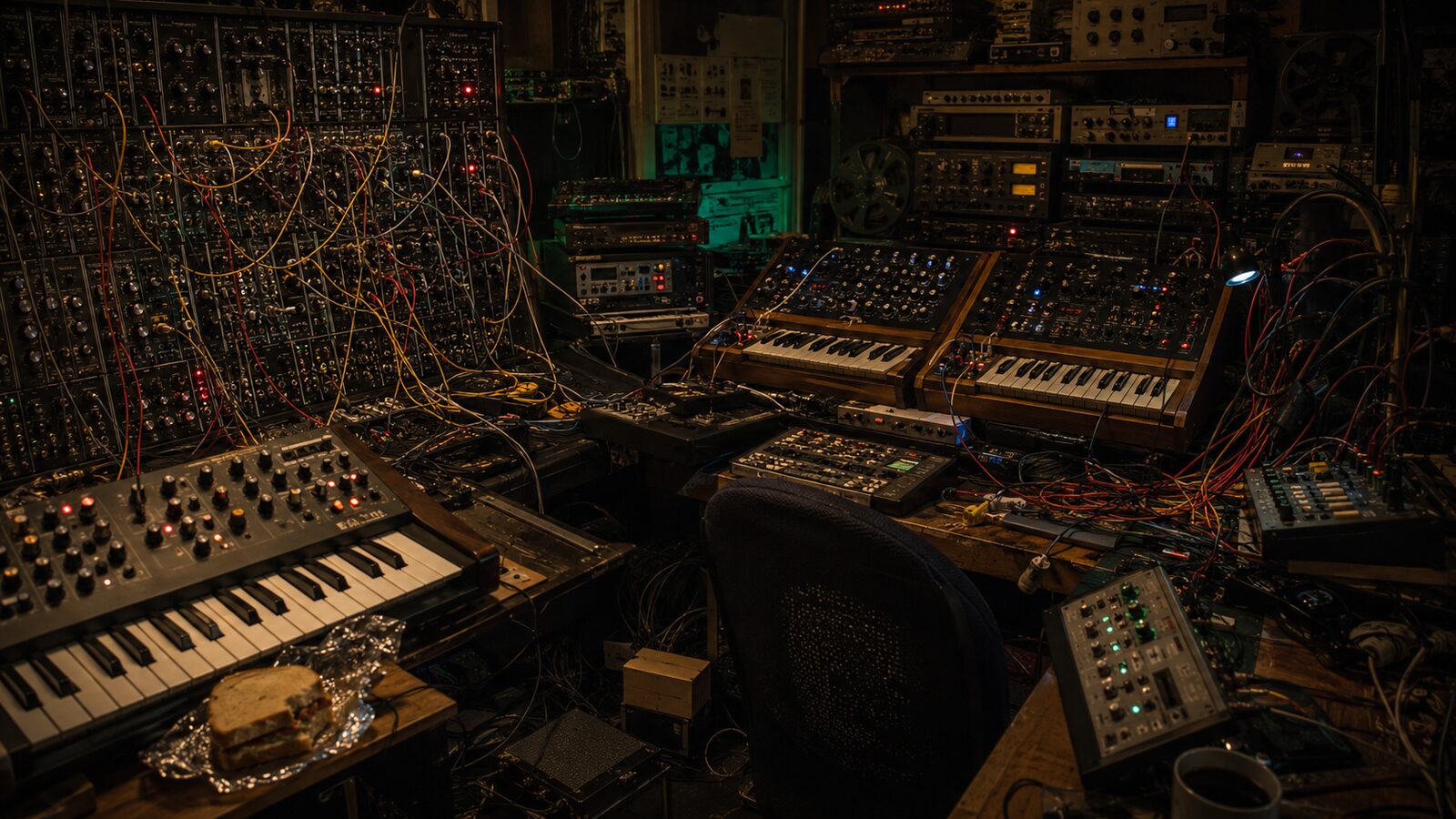
Cornwall, England, sometime in the early 2010s. Richard D. James — Aphex Twin — is working in a home studio so densely packed with synthesizers that movement requires careful navigation. Somewhere in the chaos, an ARP 2500 modular system worth more than most houses shares space with a half-eaten sandwich and a Cheetah MS800 that cost less than a bicycle.
Syro was Aphex Twin's first album in 13 years, and its arrival in 2014 was a seismic event in electronic music. But the most remarkable thing about the release wasn't the music — it was the packaging. The album sleeve, designed by The Designers Republic, featured a complete list of every piece of equipment used in the production, printed in microscopic type across the artwork.
The gear list was a deliberate provocation: a dare to gear obsessives to identify, price, and covet every item. It worked. Within days of release, Synthtopia and Equipboard had cross-referenced every entry, and eBay prices on several listed items spiked measurably.
The headline item is the ARP 2500 modular synthesizer — one of the rarest and most expensive analog synths ever made. Original ARP 2500 systems sell for $25,000 and up, when they appear at all. James has one of the most complete systems in private hands.
The album also lists two Synton Fenix semi-modular synthesizers patched together, a Make Noise DPO dual oscillator, an Intellijel Rubicon VCO, the obscure Cheetah MS800 wave-sequencing synth (which James later named an entire EP after), an Akai S950 sampler, and an Ensoniq ASR-10.
The gear list is significant because Aphex Twin literally published it as art. The Designers Republic's typography treatment turned a studio inventory into a design object — the album sleeve is simultaneously packaging, documentation, and a dare. No other artist has ever been this transparent about their tools.
I like to buy cheap instruments that most people would throw away and then find out what they actually do.
— Richard D. James (Aphex Twin)
Syro won the Grammy for Best Dance/Electronic Album in 2015 — Aphex Twin's first Grammy. The album's critical and commercial success, combined with the published gear list, created a direct pipeline from music appreciation to vintage synth collecting.
The Cheetah MS800 — an obscure 1989 British digital synth that was considered a commercial failure — spiked in price from near-worthless to $400–$800 after Syro's release and the subsequent Cheetah EP (2016). James single-handedly rehabilitated the reputation of a forgotten instrument.
The Akai S950 sampler ($400–$900) and Ensoniq ASR-10 ($800–$1,500) are more accessible entry points for collectors inspired by the Syro gear list. Both are workhorse samplers with distinctive lo-fi character that modern plugins can approximate but not replicate.
Affiliate disclosure: We may earn a commission from qualifying purchases made through links on this page, at no extra cost to you.
Akai S950 Sampler
The 12-bit sampler with the crunchy lo-fi character that defined 1990s electronic music. Affordable and distinctive.
Cheetah MS800 Synthesizer
The obscure British wave-sequencing synth rescued from oblivion by Aphex Twin. Prices spiked after Syro.
Behringer 2600 (ARP Clone)
Affordable recreation of the ARP 2600 — not the 2500, but the closest accessible entry to the ARP modular world.
Make Noise 0-Coast
Semi-modular desktop synth from the Make Noise team whose DPO appears on the Syro gear list.
Teenage Engineering OP-1 Field
Portable synth/sampler with the same 'weird cheap gear made brilliant' philosophy as Aphex Twin's studio.