The EMS VCS3 on Roxy Music's "Ladytron"
Brian Eno modified the housing himself. He played it on live television in 1972. Electronic music invaded rock and roll, and nothing was the same.
The Scene
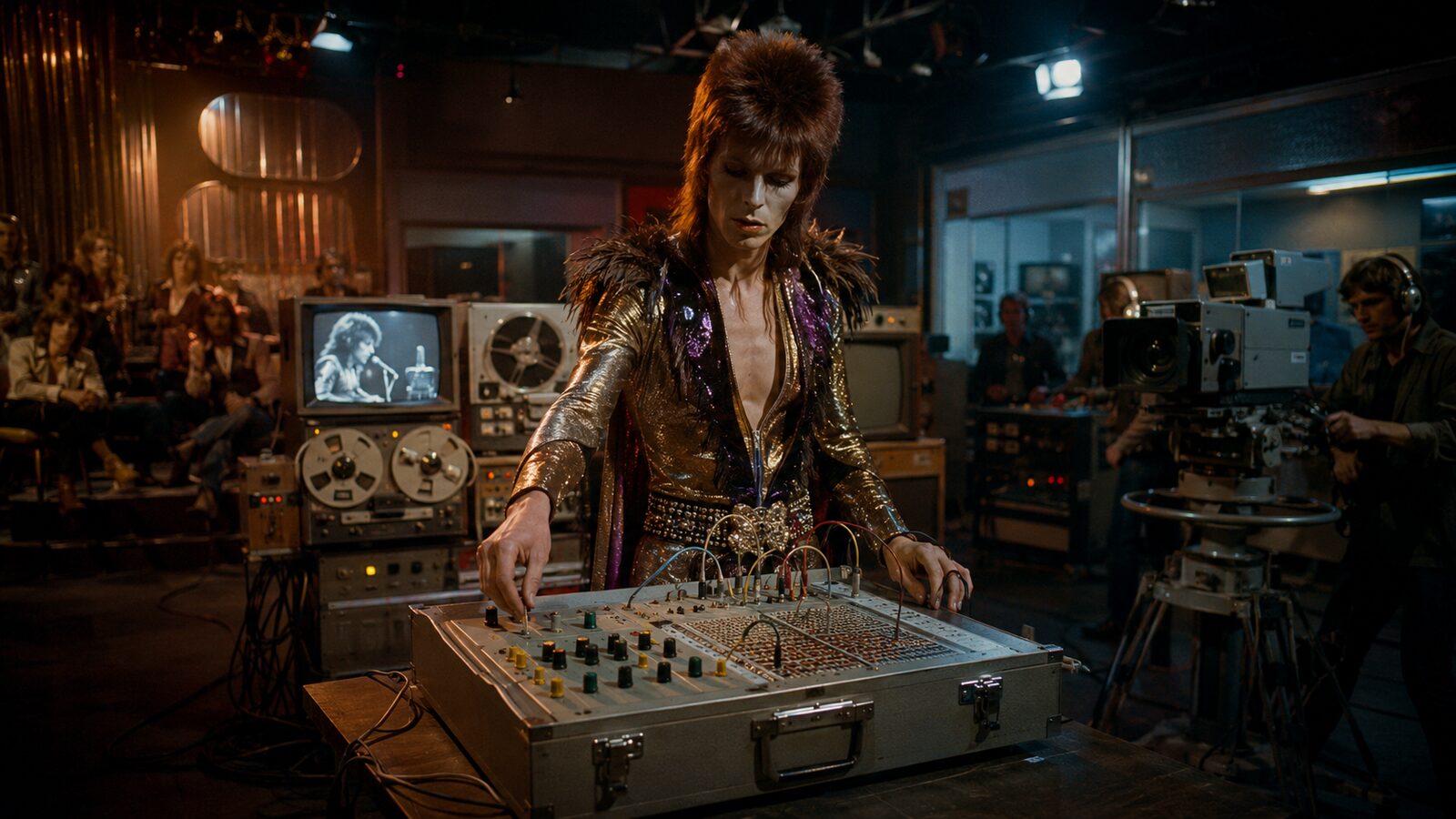
On a February evening in 1972, viewers of the BBC's Old Grey Whistle Test watched something they'd never seen before. While Roxy Music performed "Ladytron" from their debut album, a man in glam-rock attire stood behind what looked like a small grey suitcase covered in knobs, cables, and a matrix of pins. He wasn't playing guitar or keyboards in any recognizable sense. He was manipulating sound itself — feeding signals through a patch matrix, twisting oscillator frequencies in real time, generating textures that had never been heard on a rock record.
The instrument was the EMS VCS3, a portable analog synthesizer designed by Peter Zinovieff and David Cockerell in 1969. Brian Eno — who had no formal musical training and couldn't read sheet music — had modified the housing himself and taught himself to use the pin matrix as a performance instrument. The VCS3 wasn't meant to be played live. Eno played it live anyway.
The performance was a watershed. Electronic synthesis, previously confined to academic studios and experimental composition, was suddenly part of a Top 40 rock band. Eno's VCS3 work on the Roxy Music debut — particularly "Ladytron" and "Re-Make/Re-Model" — opened a door that Kraftwerk, Tangerine Dream, and eventually the entire synth-pop movement would walk through.
The Gear
The EMS VCS3 (also known as "The Putney") is a portable analog synthesizer built by Electronic Music Studios in London starting in 1969. It features three oscillators, a noise generator, a ring modulator, a spring reverb, a low-pass filter, and — most distinctively — a 16×16 pin matrix that allows the user to route any signal to any destination by inserting pins into a grid. No patch cables needed. The matrix is the instrument's signature: it turns synthesis into a spatial, tactile act.
Eno's VCS3 was modified with a custom housing he built himself, documented in Mixdown Magazine's gear rundown. He used it not as a melodic instrument but as a signal processor — feeding other instruments through it, using the filter and ring modulator to transform guitars and vocals into alien textures. This approach was revolutionary. Synthesizers were supposed to generate sounds; Eno used his to destroy and rebuild existing ones.
The VCS3 was also used by Pink Floyd (on The Dark Side of the Moon), The Who (on Who's Next), and Jean-Michel Jarre. Original units are extremely rare and command premium prices. EMS Rehberg has produced limited reissues, but demand far exceeds supply.
The VCS3 was the thing that made me think I could be a musician. You didn't need to know scales. You needed to know what electricity sounded like.— Brian Eno (paraphrased from interviews)
Why It Matters
The EMS VCS3 matters because it democratized electronic music in a way that no other instrument of its era did. It was portable (you could carry it in a briefcase), it was intuitive (the pin matrix made signal routing visual), and it was affordable by 1970s synthesizer standards. Most importantly, it didn't require traditional musical training to use — which is exactly why Eno, a self-described "non-musician," gravitated toward it.
On the collector market, original VCS3 units are trophy pieces. They appear on eBay rarely, typically in the $8,000–$20,000 range depending on condition and completeness. The EMS Rehberg reissue commands similar prices. For anyone who wants the VCS3 experience without the investment, the Behringer 2600 (a clone of the related ARP 2600) offers semi-modular analog synthesis at a fraction of the cost.
Eno's VCS3 performance on the Old Grey Whistle Test remains one of the most important moments in electronic music history — the night a suitcase full of oscillators proved it belonged on the same stage as guitars and drums.
The Gear Cards
Affiliate disclosure: We may earn a commission from qualifying purchases made through links on this page, at no extra cost to you.
EMS VCS3 (The Putney)
Portable analog synthesizer with 16×16 pin matrix. Brian Eno's instrument of choice for Roxy Music. Originals are extremely rare collector items.
EMS VCS3 Rehberg Reissue
Limited reissue by EMS Rehberg (Germany). Same circuit design and pin matrix as the original. Produced in small batches with long wait times.
Modern Alternatives
Behringer 2600
Semi-modular analog synth inspired by the ARP 2600. Patch points, spring reverb, and three oscillators — the most accessible route to VCS3-style sound mangling.
View on AmazonKorg MS-20 Mini
Compact reissue of the legendary 1978 semi-modular. Patch bay, dual oscillator, aggressive filter — a classic for experimental synthesis.
View on AmazonArturia MicroBrute
Compact analog monosynth with a patch bay, Steiner-Parker filter, and mod matrix. An entry point for hands-on analog sound design.
View on Amazon